Forbes: Meet Alex Rosen, The Small Business Savant Mixing Art and Commerce
Q&A
Forbes: Meet Alex Rosen, The Small Business Savant Mixing Art and Commerce
This article was originally published on Forbes on February 27, 2026. Photo credit Steffen Cherry.
By Steve Baltin, Senior Contributor at Forbes.
Miami-based Alex Rosen came up as a rising star in the tech world. A graduate from Stanford, Rosen was, to use a sports analogy, a can’t miss prospect. Following Stanford, she went on to work under Sheryl Sandberg on her team at Google, then Cisco, where she managed the Live Nation sponsorship, fulfilling her first-round draft potential.
Then, like so many, Rosen hit her thirties and priorities changed. Like a musician who has already experienced the feeling of chart-topping success and longs for deeper artistic fulfillment, Rosen got married, had two kids and turned her sharp mind and focus from the macro to the micro.
Now the Global head and economist of GoDaddy Small Business Research Lab, Rosen is proudly directing her efforts into helping small businesses around the globe. I spoke with the incredibly astute and personable Rosen (a poetry minor in addition to her econ major at Stanford) about the small business boom, how it is akin to the way everyone can now release music and why it is a boom for all.
Q&A Excerpts
Baltin: I have talked about this with a thousand musicians, and I wonder if it’s the same in your world. There’s a weird thing when you’re a musician and you’re in your 20s, you’re hyper-competitive, you care about charts, all that. And every artist I’ve ever talked to says the moment they become a parent, none of that matters anymore. At that point all the matters is your kid is healthy and happy and everything else is secondary.
Rosen: It’s so true. It definitely reframes everything, because I think what really unfolded for me becoming a parent was also feeling much more part of the collective. I think to your point of competition when you’re younger, you feel like you’re an individual. So, you’re almost setting yourself apart from the masses in a sense. Then you become a parent and you realize you’re just part of this continuous energy and you’re helping put more energy into the world and all of these parents are in the same boat as you. And all of a sudden you feel a lot less original. Also, your individual aspirations outside of the well-being of your family are less important because they’re only about you.
Baltin: I’ve talked about this as well with people and it’s also just aging you know unless you’re an idiot you get smarter with experience and care less what people think.
Rosen: Yeah, you do care less. Even if you’re not a parent, as you’re older you’re just not worried about what other people think about you. You have to set your own standards, you realize how important it is to have your own through line and your own value system because there’s so much noise, especially in this world now right now. There is so much noise, and I think things get buried. You ask me what’s exciting that I’m working on. I think it’s always uncovering hidden value, I feel really pulled by energy where things are vibrating just under the surface.
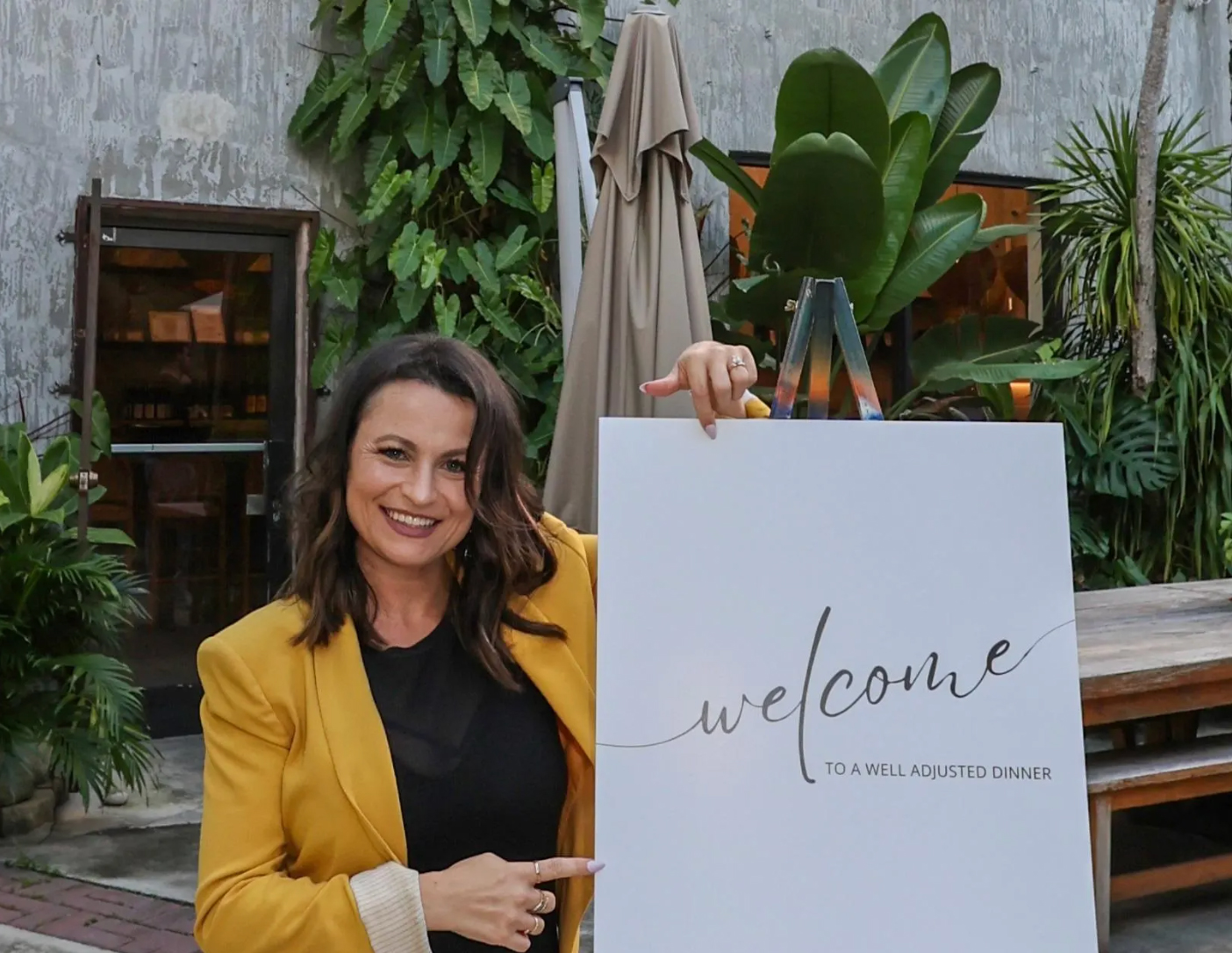
Since I moved to Miami, so many things picked up so quickly. And I’m excited about new research we put out all the time, which helps people understand small businesses better. I’m excited about the Well Adjusted Chiropractic business with my husband and people thinking about that industry differently and him actually bettering people’s lives.
When I was younger, to your point of competition, I used to think innovation had to be disruptive. Like you have to do something totally different to stand out. Now I realize it could just be a gentle alignment or reveal. Back when I was still in L.A. in a business school I remember someone said the best marketing is when someone says I could have thought of that because it feels so obvious. So, it’s not new, the value was always there. And we just have to sometimes put in the work to reveal the good.
So, I’m excited every time I see something that has value. I think if other people could see what I’m seeing, maybe they’d be more hopeful and optimistic. So, anything that makes this more accessible is exciting to me.
Right now, specifically, it’s through uncovering the impact of small businesses on the economy, helping reframe how they’re seen and talked about. They’re not a charity. They’re economically essential. Then also being an entrepreneur. That’s a whole new journey for me.
Baltin: When you’re working with small business, what resonates the most? I imagine it’s probably similar in small business to how it is in music these days. People want the human connection.
Rosen: Yeah, I think you nailed it in a lot of ways. I think technology is a great tool. Just like for music, there’s people who might not have had access to people who would have loved their music if it wasn’t for certain technological platforms and streaming that helps them reach people. I think same for small businesses. Technology has made it easier than ever to start one.
For people, whether it’s a side hustle, whether they want to pursue a passion, the cost of starting or the cost of failure, whether you’re an artist or an entrepreneur, which is not even that different anymore, is lower than ever. But what makes it is the authenticity.
People want to shop small. We have small business Saturday, people want to support their community, and small businesses are so essential. I think we all know that part. What excites me and what makes my work meaningful to me is that, again, we all want to support them and I’m able to help.
The research we do shows why they matter when it comes to the economic sense too. We know we want to help fellow humans. It’s also the tide that lifts all boats because when small businesses do better, actually our communities do better when it comes to jobs and unemployment, et cetera. So not only are you shopping from someone who puts their heart and soul into creating something, whether it’s a jam, whether it’s something at the farmer’s market, whether it’s even just local artist services, whatever it might be, a local band.
These are all entrepreneurs. I think it’s exciting that just like with music, the goal for all of us is to live our calling and to make a life while making a living. To have to be able to support our life but doing something that is the pursuit of our dream and being our own boss or control of our own destiny and crazy times. And I think small business owners do that. I’m experiencing that with [our family small business] too, just figuring that out. And just like an artist, you have to try things and see if it resonates. You’re trying to stay true to yourself. But ideally, it’s something that someone wants to participate in or listen to or feels better from is the goal.
Baltin: My dad and uncle were of that generation where they were at the same company for 50 years. That will never happen again, I don’t think. Because it does feel like it’s just so much easier for people to try something new, or it’s also like with dating sites where you are always looking at what’s better, the same feels true of job sites. Everything too so available too.
Rosen: I think that’s more likely to happen if that’s your family business and you stay with it because I think it’s really hard for us not to feel, again, like we’re working for something we believe in. And that’s our own vision. Staying somewhere made sense when the switching costs were high.
Now, thanks to technology, your ability to work from anywhere. That’s the other thing. When people worked for 50 or 60 years at the same company, they probably stayed in the same neighborhood, too. Now there are digital nomads. We have so many freedoms and so many choices for better or worse that it’s allowing people to start from anywhere, switch things up, which I can tell you economically, it’s good because it’s diversifying our economy.
There are eight jobs created for every one entrepreneur on a county level. Eight jobs because they’re either hiring directly or they want a consultant or they want a graphic designer or they bring money into the community. It’s very interesting, rapidly changing time and contextualizing it all is interesting. Poetry is emotion within a structure. It’s human, it’s someone being creative, but usually you follow a sentence structure or rhymes or something. Music is like that too. People are infusing it, but there are musical notes and there are certain rhythms.
I think small businesses are the same. I think they’re like a song, it’s them infusing their passion against some business operation. But the people I’m talking about don’t think of themselves as entrepreneurs, they wouldn’t use that term. They think like, “I love selling jam or I love showing up at the farmer’s market and offering some local good.” They’re just doing what they love and then there are guidelines and framework around it.
This article was originally published on Forbes on February 27, 2026.
Related

What Small Businesses Tell Us About the Economy That Wall Street Can’t
New research from GoDaddy and UCLA Anderson Forecast finds that small business data can offer earlier, and in some cases stronger, signals of U.S. economic performance than traditional measures such as the stock market.
Read the article entitled “What Small Businesses Tell Us About the Economy That Wall Street Can’t”
Entrepreneurial Power Rankings in Pro Football Cities
The start of football season also marks a surge for nearby entrepreneurs, proving where people gather, business follows.
Read the article entitled “Entrepreneurial Power Rankings in Pro Football Cities”
Why 2026 May Favor the Small and Connected
Small business owners are entering the year amid slowly easing inflation and ongoing cost-of-living pressures. On the surface, many of these entrepreneurs plan to hire and spend conservatively. Beneath that restraint is something closer to wild optimism—not about the broader economy right now, but about what they can achieve over time.
Read the article entitled “Why 2026 May Favor the Small and Connected”