
US entrepreneurs skew older than counterparts in the UK
Data Forward
US entrepreneurs skew older than counterparts in the UK
The big fact
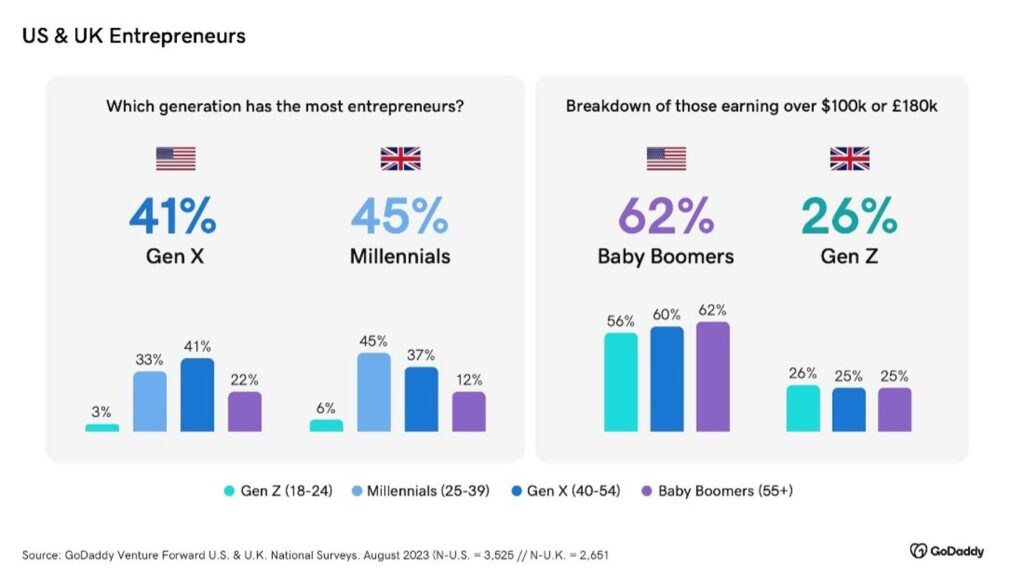
Microbusiness owners in the U.S. skew older than those in the U.K. In the U.S., 63% of microbusiness entrepreneurs are Generation X (age 40-54) or baby boomers (age 55+), compared to 49% in the U.K., where millennials (age 25-39) take the lead.
Older generations make more in the U.S.
One in six microbusiness owners from all generations earn over $100K or £180K, but the breakdown in age groups differs between the U.S. and U.K.
In the U.S., the older the microbusiness owner, the more they make, compared to the U.K., where earnings are more evenly split among age groups. In the U.S., 60% of Gen X and 62% of baby boomers earn over $100K, while 25-26% of Generation Z, Gen X and baby boomers from the U.K. report revenue over £180K.
More money, less optimism
Despite being the highest earners, baby boomers in the U.S. report less optimism about their overall expectation for their business during the next six months, with only 65% indicating a positive outlook, compared to 77% of Gen Z respondents.
Additionally, entrepreneurs who generate significantly more revenue, particularly those with over $600K or £500K, reported higher levels of stress, anxiety and burnout.
Younger generations may be more entrepreneurial
Not only is Gen Z the most optimistic group of microbusiness owners in the U.S., but they may also be the most entrepreneurial. 37% of Gen Z in the U.S. always dreamed of starting their own businesses, versus the 22% of Gen X and 15% of baby boomers, according to Venture Forward data. A recent study revealed that 50% of Gen Z aspire to become an entrepreneur.
And, in the U.S., 75% of Gen Z hope to turn their microbusiness into their primary source of income, compared to 58% of baby boomers, who often start a side business after retirement or continue one as a hobby.
The research
GoDaddy’s Venture Forward research initiative analyzes more than 20 million online businesses with a digital presence (measured by a unique domain and an active website). Most of these businesses employ fewer than ten people, categorizing each as a microbusiness. While these microbusinesses may be small, their impact on economies is outsized even though they are often too informal or too new to show up in traditional government statistics.
Since 2018, Venture Forward surveyed more than 36,000 small business owners with a digital presence, making it the source for microbusiness data and insights.
More Stories & Use Cases


Why 2026 May Favor the Small and Connected
Small business owners are entering the year amid slowly easing inflation and ongoing cost-of-living pressures. On the surface, many of these entrepreneurs plan to hire and spend conservatively. Beneath that restraint is something closer to wild optimism—not about the broader economy right now, but about what they can achieve over time.
Read the article entitled “Why 2026 May Favor the Small and Connected”
GoDaddy & HarrisX: How Americans Turn Uncertainty into Opportunity
Amid the U.S. government shutdown, a new national poll from GoDaddy and HarrisX reveals that Americans — including federal government employees directly affected by the shutdown — are responding with resilience and turning uncertainty into opportunity.
Read the article entitled “GoDaddy & HarrisX: How Americans Turn Uncertainty into Opportunity”
The Future of Entrepreneurship Is Leaner, Smarter, and More Resilient
As the economy shifts, small business owners across the country are rethinking what success looks like. New research from GoDaddy shows they’re not stepping back — they’re adapting, staying focused, and moving forward.
Read the article entitled “The Future of Entrepreneurship Is Leaner, Smarter, and More Resilient”
How AI is Amplifying Small Business Impact on Local Economies
2024 saw a huge leap in the adoption of AI and the rollout of new tools, which led to surges in the number of new websites coming online.
Read the article entitled “How AI is Amplifying Small Business Impact on Local Economies”