Opinion
Why 2026 May Favor the Small and Connected
By Alexandra Rosen, Global Head of GoDaddy Small Business Research Lab. This article was originally published on small.news on January 12, 2026
My economic forecast for small businesses in the United States is not one of dramatic acceleration in 2026, but of durable momentum.
Small business owners are entering the year amid slowly easing inflation and ongoing cost-of-living pressures. On the surface, many of these entrepreneurs plan to hire and spend conservatively. Beneath that restraint is something closer to wild optimism—not about the broader economy right now, but about what they can achieve over time.
They tread lightly, building businesses in every type of zip code, requiring little to start, and sometimes existing only online. But don’t let their size fool you: these businesses lift household incomes and spark hiring in local communities.
After a surge in volume of businesses born both out of opportunity and necessity in the last five years, the numbers continued to increase in 2025 in almost every state. What really grew was small business website activity—up nearly 20% year-over-year.
That trajectory matters because it signals that the last several years were not a temporary spike in entrepreneurship driven by crisis. Instead, they marked a structural shift in how people enter, remain in, and shape the economy through small business ownership. 2026 is set to extend this trend.
Anywhere, Anytime, At a Lower Cost
Technology has fundamentally changed when, where, and how easily people start businesses and will continue to do so in 2026. It has also enabled greater resilience, as they can recover quickly when something doesn’t work, and faster scaling by delegating tasks to AI-enabled agents and tools as partners. These shifts have lowered the cost of entry, maintenance, and failure, dramatically shortening the distance between idea and execution.
What once required significant upfront investment is now often launched with little more than a domain, a website, and a willingness to test ideas. Domains, social media, payment systems, and AI tools for content, customer service, and business insights have made experimentation fast and accessible.
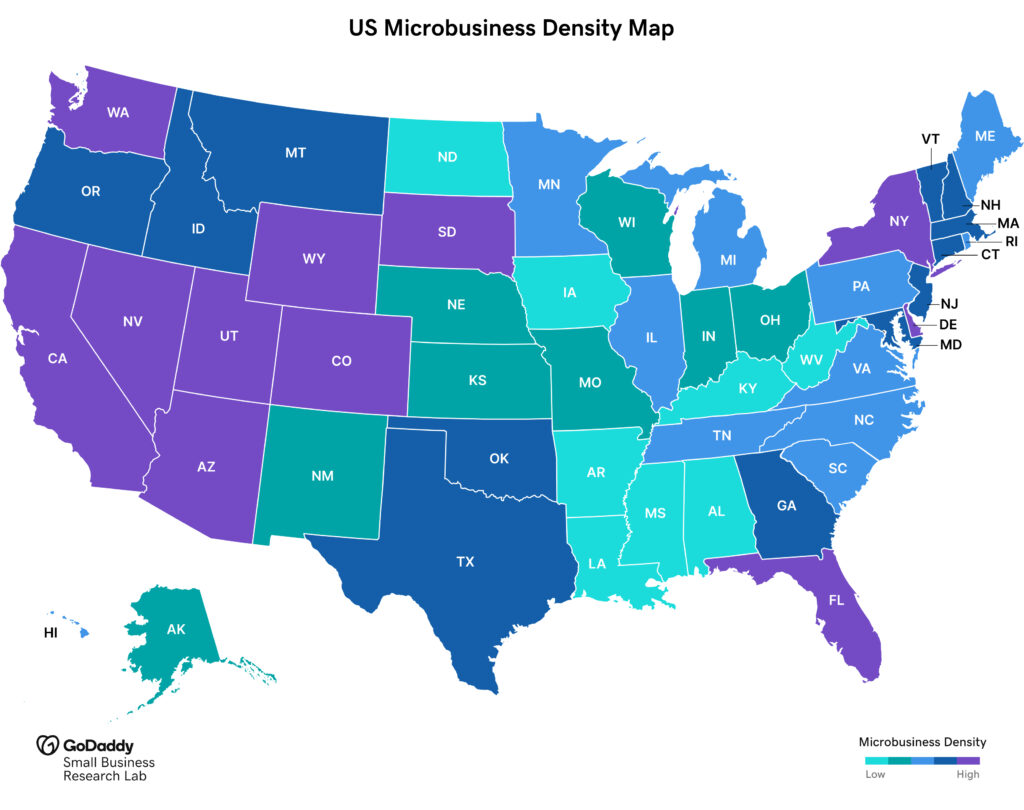
This has been captured by the evolving geographic distribution of small business activity. During the pandemic, rural areas and suburbs closed the gaps with larger cities. Displaced employees, remote workers, and people reassessing where they wanted to live brought business creation with them. For example, the 2024 Annual Report revealed that areas with more new residents also had a higher density of small businesses.
As increased technology access and decreased cost of failure have impacted the pace of entrepreneurship, and with January being a month of new resolutions, we’re likely to see a jump in ideas and businesses coming to market. Heading into 2026, cost-of-living pressures are likely to keep pushing that energy outward, with more of those early pops showing up in places that don’t usually make the headlines.
Making a Life While Making a Living
Many businesses are intentionally full-time or part-time. They are built to support flexibility, supplement income, or align with a specific season of life. We’ve found:
- 45% of entrepreneurs say their small business is their main source of income.
- 40% say it is a supplemental income source.
- 1 in 3 microbusiness owners contribute more than 50% of their household income from their venture.
This flexibility has proven especially meaningful during periods when surrounding labor and policy environments can feel volatile or opaque. This may be behind the tenacity to maintain a small business or start a new one that we’ll likely see this year, despite macro factors that can be reported as intimidating or unpredictable. We’ve consistently seen small business owners report a more positive outlook on their own performance than on the national economy since 2019.
Community Connection and Impact – The Long-Tail of Small Businesses
In addition to community connection, the community impact made by small businesses has only grown, and that will likely continue. What started as two jobs created in a community from each digital small business, in 2025, was found to more than double into about eight jobs per new entrepreneur on a county-level. In addition, household median income grows by thousands of dollars thanks to the presence of small businesses locally.

Small businesses enrich communities culturally and financially. Data shows many small businesses are locally-focused: two-thirds of small business owners said most of their customers live within their city or state, reinforcing the importance of proximate connection and community engagement.
Optimism in the Wild: What 2026 Signals
Economically, 2026 is currently positioned to be a year of steady entrepreneurial growth in the U.S. Inflation pressures have eased somewhat, but remain, and consumer spending as well as job stats are jumping around a bit.
Regardless, small businesses are no longer an alternative to traditional employment or economic participation. They are part of the core infrastructure and allow people to participate economically in ways that better align with their lives and comfort with risk.
Technology will continue to make starting and scaling easier. For example, the use of AI by small business owners has increased rapidly, but is still below 50%. This year will see that number rise exponentially, along with challenges in balancing efficiency with uniqueness.
These entrepreneurs are betting on themselves and not slowing down. If we want to fuel broad economic growth, we should think small and devise ways to support these vital community-building entrepreneurs as they invest in their dreams.
Related

The Future of Entrepreneurship Is Leaner, Smarter, and More Resilient
As the economy shifts, small business owners across the country are rethinking what success looks like. New research from GoDaddy shows they’re not stepping back — they’re adapting, staying focused, and moving forward.
Read the article entitled “The Future of Entrepreneurship Is Leaner, Smarter, and More Resilient”
Cautiously Optimistic, Small Businesses Are Steadfast In Today’s Economy
Recently, headlines have been dominated by news about tariffs and market disruptions, and a top of mind question for everyone is: what does the economic news of today mean for small businesses? Are they worried?
Read the article entitled “Cautiously Optimistic, Small Businesses Are Steadfast In Today’s Economy”
How AI is Amplifying Small Business Impact on Local Economies
2024 saw a huge leap in the adoption of AI and the rollout of new tools, which led to surges in the number of new websites coming online.
Read the article entitled “How AI is Amplifying Small Business Impact on Local Economies”