
Research
Small Business Owners Are Defining An Empowerment Economy
By Alexandra Rosen, small business economist and global head of the GoDaddy Small Business Research Lab
Entrepreneurial activity is accelerating. And I’m not referencing startups emerging in the usual hubs. In the last year, new business applications across the United States rose over 15%, and between July 2025 and June 2026, the number of digital small businesses that the GoDaddy Small Business Research Lab tracks grew by about 10%. For example, the most entrepreneurial city in California was Fresno when calculated by momentum, meaning growth rate, not absolute count. Owning a business, whether full-time (about 49%) or side-hustle, has never seemed more prevalent or accessible.
This is the Empowerment Economy: a time when more people have more ways to earn a living and more freedom to define success on their own terms.
Economic empowerment is not about having the perfect conditions. It is having more choices when conditions are imperfect. For over seven years, GoDaddy’s Small Business Research Lab has investigated the reasons people start small businesses, and our results reveal 2:1 ratio on betting on oneself vs. the macroeconomic conditions. In 2026, four consecutive surveys show that about two thirds of small business owners have a positive outlook on their business revenue over the next six months, while only about one third are optimistic about the national economy.
Here is a commonly cited equation: more jobs or hiring = bigger business = stronger economy and greater success.
But success isn’t measured purely by size or even survival. Around a third of entrepreneurs are their household’s main breadwinner, contributing over 51% of household income through their venture. Of that group, nearly one in five (20%) sold or closed a business without any profit.
Then there’s the evolution of what growth means, and it’s not necessarily adding employees to payroll anymore. It can mean more revenue, higher owner income, greater flexibility, a larger footprint or brand, working with contractors, or using AI and technology to scale operations.
In many cases, staying small is the intention. GoDaddy data backs that up. Among owners who want to remain solo or small, the top reasons are work-life balance at 17%, personal wealth goals at 16% and the amount of time they have available at 14%.
It is not primarily lack of money, appetite for risk or opportunity driving that decision. It is a choice about how to make a life while making a living. Their motivations for starting are equally varied: being their own boss, pursuing a hobby or passion, flexibility and believing they can have more success on their own have remained among the top reasons for years. Choice is part of the story, and choice is a strength.
Small also doesn’t mean economically insignificant, as they’re not only affecting their households, but fortifying our economy. Research we published with UCLA Anderson Forecast earlier this year, “What Small Businesses Tell Us About The Economy That Wall Street Can’t”, found that small business formation is associated with future payroll growth and lower unemployment. It also found digital microbusiness and small business activity can signal changes in the broader economy that traditional measures miss or capture later, providing a deeper understanding of economic activity.
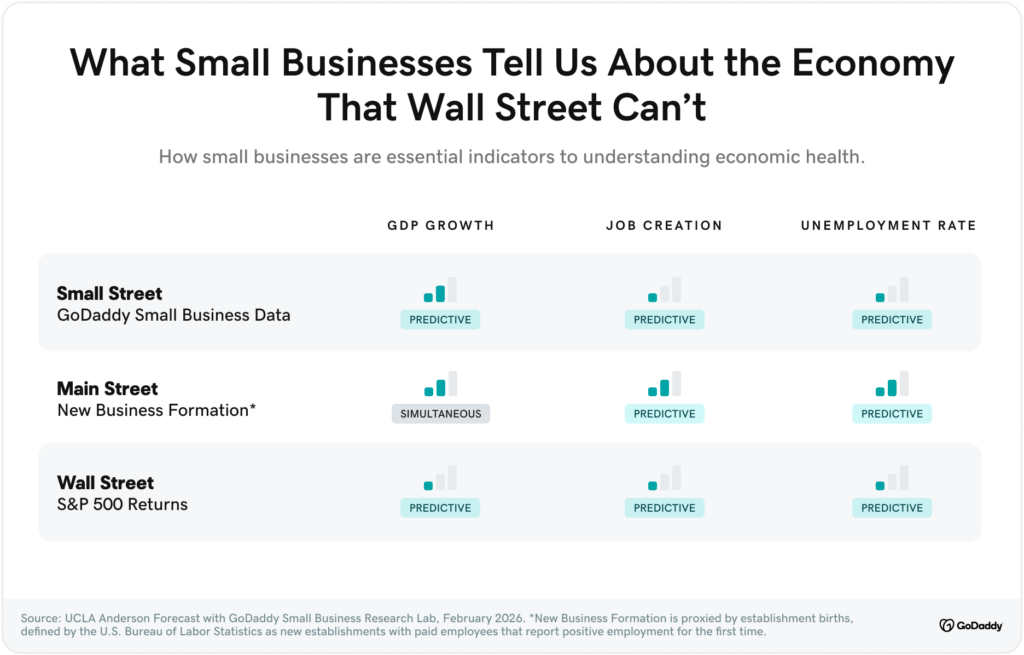
Image available for download here.
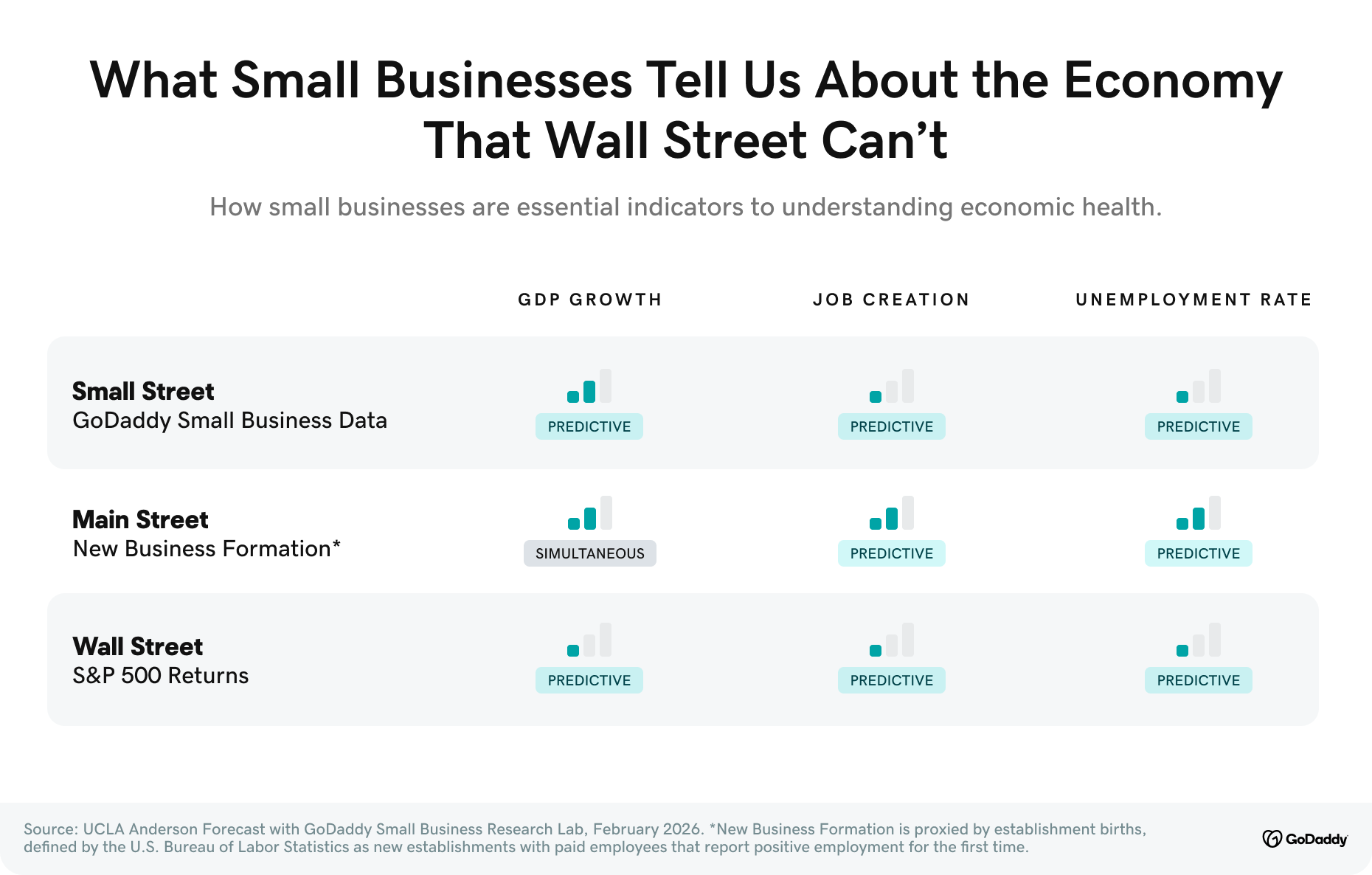
- Locally, each additional entrepreneur is associated with 5 jobs at the county-level by hiring, engaging or creating more demand for other services.
- Communities with more online small businesses have experienced greater household median income growth and greater resilience during economic downturns.
And what we’re seeing is that entrepreneurial activity itself is accelerating. It did not disappear when the pandemic ended. It continued to grow, helped by infrastructure that had already been put in place through broadband investment, digital adoption, policies, programs and other public and private investments.
Technology has continued to lower the cost and friction of testing an idea, finding customers, getting feedback, reaching beyond your geography, and even restarting if needed.
What makes this an Empowerment Economy is not simply the continued desire to be your own boss or pursue a passion. It is not even the increased rate at which technology, especially AI-enabled tools, is making business ownership a more commonplace part of everyone’s life and removing the friction to start, scale or move forward. It is the combination of the two; it is having more choices amid all kinds of circumstances – personal and macroeconomic. And that yields new metrics to add to the mix as well.
For the first time, we have real-time data not just what’s happening but also its impact, allowing us to see and understand the individuals better understanding them, and therefore to better support them. Supporting small businesses is not a goodwill gesture; there is an economic case for it. For those working to solve business challenges, the task is to meet entrepreneurs where they are and keep the pace of support with the rate of accelerated entrepreneurship. Because as small businesses redefine success and get stronger with the power of technology under them, so does the U.S. economy.
Related
GoDaddy & HarrisX: How Americans Turn Uncertainty into Opportunity
Amid the U.S. government shutdown, a new national poll from GoDaddy and HarrisX reveals that Americans — including federal government employees directly affected by the shutdown — are responding with resilience and turning uncertainty into opportunity.
Read the article entitled “GoDaddy & HarrisX: How Americans Turn Uncertainty into Opportunity”
Why 2026 May Favor the Small and Connected
Small business owners are entering the year amid slowly easing inflation and ongoing cost-of-living pressures. On the surface, many of these entrepreneurs plan to hire and spend conservatively. Beneath that restraint is something closer to wild optimism—not about the broader economy right now, but about what they can achieve over time.
Read the article entitled “Why 2026 May Favor the Small and Connected”
Discover the Most Entrepreneurial Cities of 2025
Entrepreneurs are reshaping local economies and redefining what's possible. From vibrant metros to unexpected suburban powerhouses, explore GoDaddy’s latest global ranking to uncover the fastest-growing entrepreneurial hotspots across the US, UK, and Australia.
Read the article entitled “Discover the Most Entrepreneurial Cities of 2025”