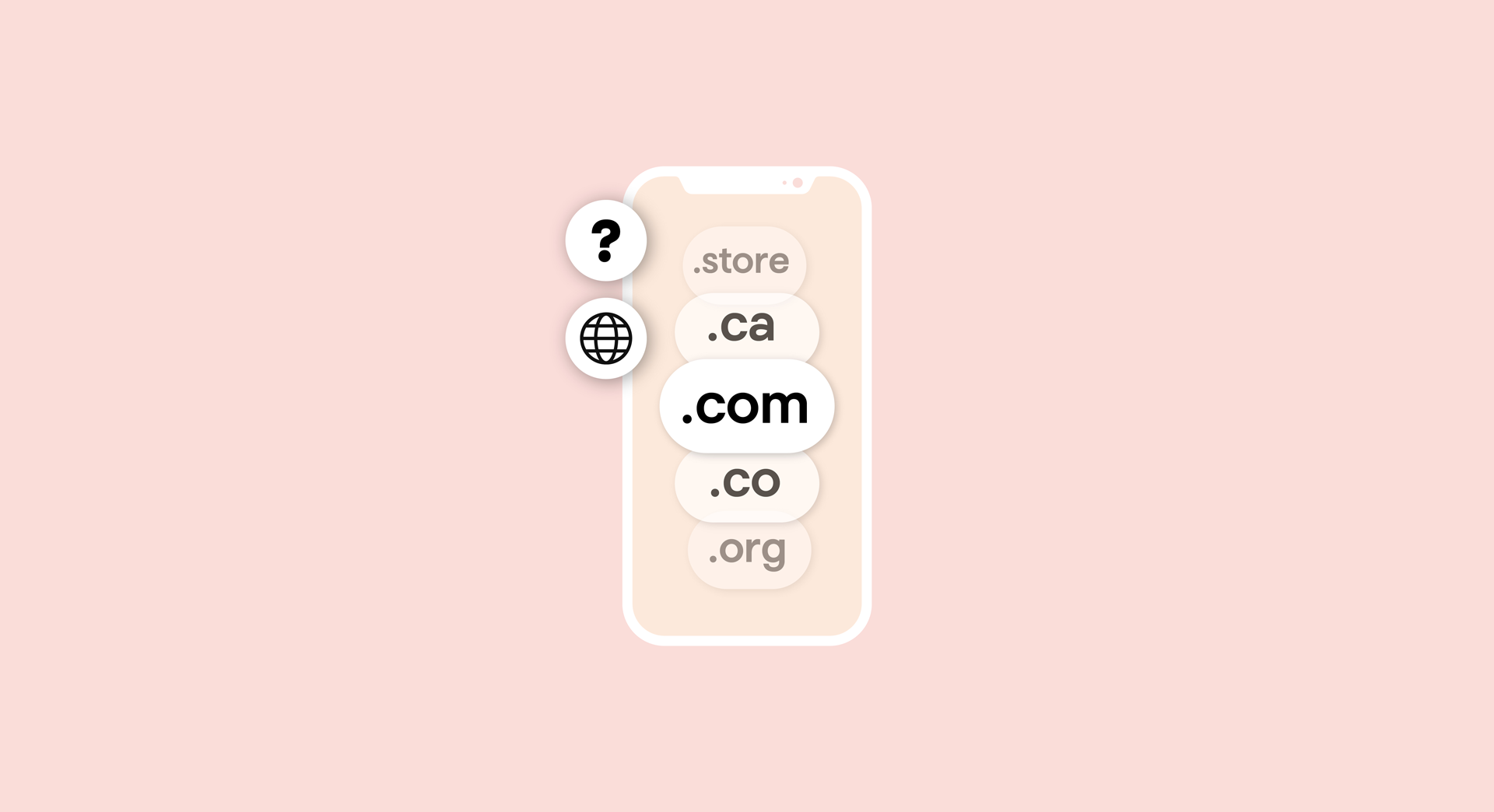

If you're buying your first domain name, there are currently over 550 domain extensions available, which can feel very overwhelming if you’re not sure which one to pick. Should you just get the .com domain? And is a .com domain really better?
The short answer is that a .com domain name is globally recognized, which does give it certain advantages over some other domain name extensions.
But that's not the only factor in play when it comes to choosing a domain name. Let's explore the issue of whether a .com domain is better by looking at the factors in play.
Check to see if the domain you want is available now
What is a .com domain?
A .com domain is short for "commercial" and is the most popular top-level domain (TLD) extension.
A domain extension is the bit that comes after the dot in a domain name.
If you’d like to go a bit more in-depth about all things domains, check out our guide on the most common domain questions, including how domains work and what the different parts of a domain name are.
The .com domain is just one of many hundreds of TLDs available today. But in this post, we're going to focus on practical uses of the .com TLD, so let's talk about the advantages of a .com domain.
Advantages of a .com domain
One of the early TLDs introduced when the Domain Name System (DNS) was first created in January 1985, .com is a true classic.
- It’s widely known around the world: Most people know the .com extension, which means it adds trust to your website.
- It doesn't tie a website to a particular location: If you're looking to do business in more than one location, then .com provides you with a domain name that will work well in most markets.
- It’s easy to remember: The fact that it's short and well-known means that people could be more likely to remember your website's address if it ends with .com, rather than a newer, longer TLD.
Having a .com domain can also be beneficial in case you want to sell the domain name at some point in time.
That may not seem like a huge list of advantages, and it's true that in many cases an alternative domain extension will work just as well as a .com domain. (You may also find there are cheaper domain names than .com.)
For example, there is no inherent search engine optimization (SEO) advantage in going for a .com domain name (despite a persistent myth that there is).
The one drawback to .com
There is one significant disadvantage to opting for a .com domain, and that is its popularity.
You may find that the domain name you want has already been taken on .com.
In such a case, you might have to switch to another domain extension to get the domain name you want. Just make sure that you aren’t violating any intellectual property, such as trademarks, when buying your domain.
Related: Comparing the best domain registrars
Which is better .com or .ca?

Both .com and .ca domain names have a great deal of appeal for Canada-based websites, and neither one is inherently better than the other.
If you're planning to focus entirely on the Canadian market, then you may decide that a .ca domain suits your needs perfectly.
Equally, if you're planning to attract website visitors/customers from outside the country, then you may want to go for a .com domain.
It can also be a good idea to buy both the .com and the matching .ca versions of your domain name. That way, you can make sure:
- People searching for you online will find you no matter which extension they type in
- No one else can buy the one you didn't buy and use it to snaffle away visitors
When you're ready, you can search for a domain name here.
Need a little help? Try GoDaddy's free domain name generator.
Summing up
Buying a .com domain does offer certain advantages, but you may need to be flexible if you're set on getting a .com domain.
You may also want to buy your domain name across multiple domain extensions in order to protect your brand. If the domain name you want is already taken, our domain lookup tool can help identify the owner's details so you can reach out to them about a potential sale.
Frequently Asked Questions
What is a domain extension?
A domain extension is essentially the lettering that appears after the second dot in your web address. For example, the extension in GoDaddy.com is .com.
Is it better to use .com or .co?
Although .com is often considered the go-to extension, both extensions have merits. Since .com is incredibly common, this could mean that your ideal .com domain has already been taken. If this is the case, then .co is a great alternative. Since it’s shorter and sharper, it’s more likely to stay in people’s heads and help them to remember your business.
Is .com still the best domain extension?
While no domain extension is the best, .com is undoubtedly the world’s favourite, with more than 157.2 million .com domains registered in total.
Its success can be owed to its simplicity, low cost, and the fact that it’s one of the original extensions that was created in 1985, making it a bona fide classic.
What are the advantages of a .com domain?
As one of the original domain extensions, .com has effectively become synonymous with the internet, making it an obvious choice for most businesses.
For example, a person looking online for a business named Joe's Barber Shop will often type in joesbarbershop.com on the first try.
On top of that, .com is affordable, easy to remember and can be registered by anyone, no matter what they do or where in the world they’re based.
What is the advantage of .ca domain?
The main advantage of .ca is that it’s an established domain extension that’s trusted by Canadians.
Having a .ca domain also tells the world you’re a Canadian business, plus it’ll help boost your ranking in regional search results, as Google frequently prioritises websites with local domain extensions over international sites for searches made from Canada.
Why does Canada use .ca instead of .com.ca?
The simple answer is that the domain extension .com.ca doesn’t actually exist.
Which domain extension is best for SEO, .com or .ca?
While .com domains are ideal for businesses with a global presence, .ca domain names have higher search rankings in Canada as they’re associated with Canadian businesses.
Search engines strive to deliver the most relevant results to Canadian searchers, and they use geographic clues to do this.
That said, it’s worth considering where you expect your business to be in the next few years. If you’re thinking of expanding your operations overseas, then it’s worth investing in a .com domain, as it’ll give you more leeway with your branding.
How do I decide between a .com and a .ca domain for my website?
If your services are restricted to Canada, then you should absolutely use a .ca domain for your website. Having one will immediately tell prospective customers that you’re based in Canada, plus it can help you appear higher on local searches. If, however, you provide international services, then a .com may be better suited to your needs, as its high value and authority will lend you more support on search engines.
Should I buy both .com and .ca domains?
Absolutely! Having multiple variations of the same domain name can be hugely beneficial, as it will help your website to appear in both local and international search results.
Because .ca is associated with Canada, search engines give websites with this extension priority for web searches that originate in Canada.
Even if you don’t want to target a global audience, having both versions will ensure that people will always end up at your website, regardless of which one they use.
Registering the .ca domain that matches your .com will also prevent anyone else from taking that domain and potentially using it for malicious purposes.
What is the best domain suffix for a new business?
That depends on your business needs. If you just want a simple web address, then .com should do you fine.
If you plan on selling your products or services online, then a .shop or .store is an excellent choice, as customers will immediately see that you have stuff on offer.
If, however, you want to attract local customers, you could use the official extension for your country or city for your web address.
For example, Canada has .ca, Quebec has .quebec, Germany has .de, Barcelona has .barcelona — the list goes on.
Alternatively, you could use a unique extension that highlights your occupation/service, like .design, .plumbing, .car, or .vet.