Over the course of 2025, the GoDaddy Pro team spent hundreds of hours speaking directly with freelancers, studio owners, and agency leaders across the digital services landscape. We conducted in-depth, first-hand interviews with Pros from around the world, such as designers, developers, marketers, and full-stack digital specialists who build and maintain the web for millions of small businesses.
To complement those conversations, we partnered with Promethean Research to field larger, statistically meaningful studies that helped us validate trends, quantify sentiment, and understand the broader forces shaping the digital agency ecosystem today and in the years ahead.
Why we invested so deeply in this research
We undertook this work because GoDaddy is deeply committed to becoming the go-to platform for digital professionals. We know freelancers and agencies are the backbone of the modern web, and our mission is to empower them with everything they need to start, run, and grow their businesses.
And as we conducted these interviews, something interesting happened: almost every Pro we spoke with wanted to know what everyone else was saying, doing, struggling with, or learning.
Many Pros told us they rarely have access to market-wide data and rely heavily on peer communities to understand how the industry is changing. They join networks, private groups, and forums because insights shared by other Pros directly influence how they price, package, hire, market, and scale.
So, for this end-of-year roundup, we want to pay that forward. This report represents the major patterns, lessons, and opportunities we uncovered throughout 2025, shared openly to help freelancers and agencies make smarter, more confident decisions in 2026.
10 key takeaways from web designers and developers in 2025
We’ve gathered the ten most important themes we heard this year, distilled from interviews, data, and real-world stories shared by the very people shaping the web today.
Want to learn more? Join the insiders in the GoDaddy Pro Facebook community, run by the team that collected these insights. We share everything we learn about the industry in this community of digital professionals and ask for feedback about how GoDaddy can improve the experience for web professionals.
1. Everyone enters this industry from a different door, but all grow into multi-disciplinary roles
If there’s one theme that immediately crushed any ideas about “the right way” to become a web professional, it’s this:
Nobody starts in the same place, and it doesn’t matter. What matters is how well you serve your clients and how committed you are to learning what they need next.
Some Pros began as graphic designers. Others came from IT, healthcare, accounting, construction, or completely unrelated careers. One told me:
“I dropped out of high school at 17 and built 400–500 websites since then.”— Rob
Another started in video production:
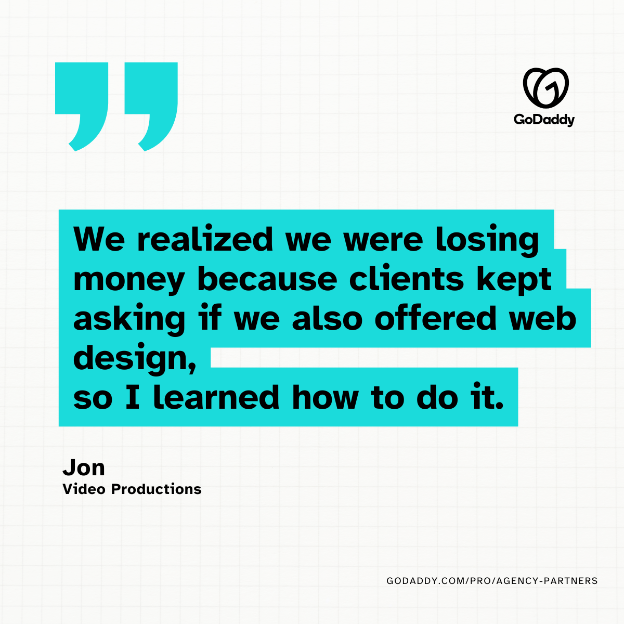
Here’s the truth that became obvious interview after interview:
The most important skill in this industry isn’t code or design. It’s the willingness to learn as you go.
Nearly every freelancer and agency owner described a similar journey:
- They started with one offering.
- A client asked for something new: Can you build our website? Can you help with email? Can you manage our hosting?
- Instead of saying no, they figured it out.
- That curiosity and adaptability became the bridge: from freelancer → multi-disciplinary professional → full-fledged agency.
Some didn’t even realize they had become an “agency” until years later. They were simply responding to what their clients needed, one project at a time.
And that’s the part I hope everyone reading takes to heart:
- You don’t have to come from a traditional background.
- You don’t need a degree in design or computer science.
- You don’t need to have everything figured out before you start.
Every single Pro we spoke with grew by being resourceful, by saying “yes” before they fully knew how, and by trusting that they could learn anything necessary to help their clients succeed on the web.
It doesn’t matter where you start, it’s how you show up for your clients, how you keep improving, and how you stay curious enough to grow into whatever they need next.
Takeaway: Pros become multi-disciplinary not because they planned it, but because they cared enough to learn. This industry rewards adaptability far more than pedigree.
2. WordPress (still) dominates because it’s what pros know and clients expect
Across every interview, from early-career freelancers to seasoned agency owners, one truth kept resurfacing:
WordPress remains the professional standard for building powerful, flexible, client-friendly websites.
Even pros who experimented with tools like Webflow, Framer, and Squarespace consistently returned to WordPress when a client needed:
- Custom integrations
- Complex functionality
- Robust SEO
- Ecommerce
- Membership systems
- Long-term scalability
As one designer put it:
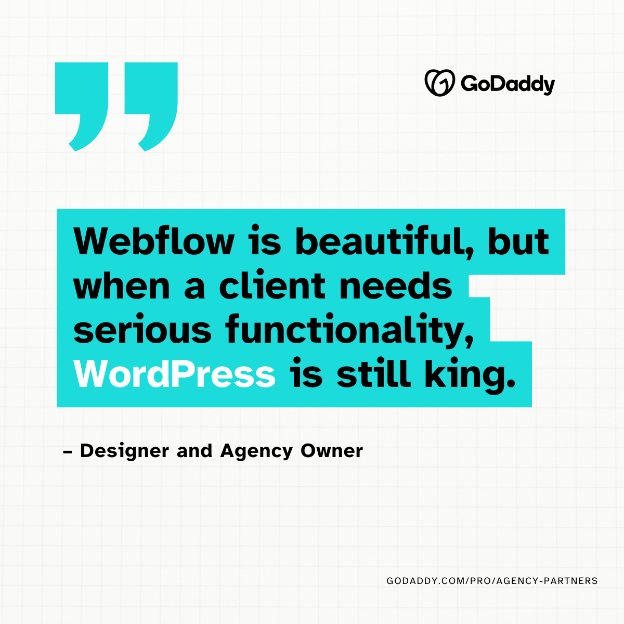
And for many Pros, the decision wasn’t even a debate. It was simply the tool they grew up on.
Some found WordPress through online courses. Others Googled their way into it. And many, like one freelancer we spoke with from Upwork, were pointed to it by mentors:
“Everyone told me: If you want to learn how to build websites, start with WordPress and Elementor.”
What really stood out in these conversations was trust. WordPress may not be the newest tool on the block, but it’s the one that consistently supports the wide range of jobs Pros must do.
A quick note about GoDaddy and WordPress
Because so many of the people we interviewed rely on WordPress daily, it’s important to acknowledge our own relationship with the ecosystem.
GoDaddy is, and has always been, deeply invested in the WordPress community:
- We sponsor WordCamps around the world
- We maintain contributions to the open-source project
- We actively support WordPress creators, educators, plugin developers, and agencies
- We’ve built our hosting around what real-world WordPress sites need, not just what looks good on paper
And the feedback from Pros and reviewers this year made something incredibly clear:
GoDaddy’s WordPress hosting is becoming one of the fastest and most reliable options in the industry.
In fact, WP Mayor recently said our Managed Hosting for WordPress is “like having a website that loads before you can even finish blinking.”
That praise wasn’t accidental. It’s the direct result of listening to Pros, optimizing for performance and stability, and making sure our platform delivers the speed, uptime, and support required to run modern WordPress businesses.
Takeaway: WordPress continues to power a major portion of the web because it helps freelancers and agencies deliver real results for real clients. And at GoDaddy, WordPress is more than a product. It’s a community we care deeply about and a platform we continuously invest in to help Pros succeed.
3. Recurring revenue (maintenance + hosting) is the true heartbeat of agency businesses
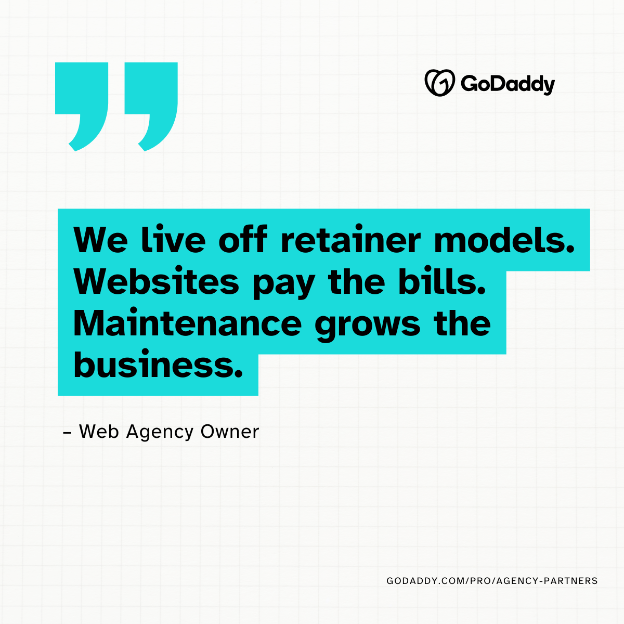
Nearly every professional I spoke with said some version of, “The website build is great, but the real money is in the maintenance contract.”
Across freelancers, studios, and full agencies, the pattern was undeniable: recurring revenue is what creates stability. And the models vary. Monthly plans, quarterly retainers, pre-paid support blocks, or “call us when you need us” troubleshooting all point to the same truth:
Clients need ongoing help. Pros need a predictable income.
One agency owner explained it simply:
Another freelancer explained that maintenance often leads to more project work:
“People come to me with a problem. Fifteen minutes later, I fix it, and 20% of the time they ask me to rebuild their whole site.”
And whether a Pro is managing five sites or 50, one theme stood out:
The more sites a Pro manages, the more they value automation, centralization, and visibility across all their clients.
How GoDaddy supports recurring revenue for agencies
Because maintenance is such an essential part of how agencies operate, GoDaddy has invested heavily in tools that simplify and streamline this work.
The Hub by GoDaddy Pro
The Hub gives designers and developers a centralized dashboard to manage all their clients’ websites in one place. This includes updates, security checks, site monitoring, backups, and more, regardless of where those sites are hosted.
Pros repeatedly told us that they want one place to see everything happening across their entire client portfolio, and the Hub was built precisely for that.
Site Maintenance Packs for any WordPress website
For Pros who want to turn maintenance into a repeatable, packaged offering, our Site Maintenance Packs provide a turnkey way to deliver professional updates, backups, monitoring, and performance checks — even for websites not hosted at GoDaddy.
That flexibility is important, because many agencies inherit sites on a mix of hosting providers, and they can’t always migrate everything immediately. Being able to standardize maintenance across any WordPress site helps Pros:
- scale their recurring revenue
- deliver services more consistently
- reduce the overhead of managing multiple tools
- increase client retention and long-term value
Takeaway: Recurring revenue provides the safety net that allows freelancers and agencies to grow sustainably. Tools that make maintenance easier—automation, centralized dashboards, cross-hosting support, and standardized care plans—directly fuel the financial engine Pros rely on.
And GoDaddy’s Hub and Site Maintenance Packs are designed to make that engine run smoother, faster, and more profitably.
4. Pros don’t care about tools, they care about speed, reliability, and support
One of the clearest themes that emerged this year is that most successful freelancers and agency owners are not emotionally attached to specific tools or platforms. They experiment, adapt, replace, reconfigure, and reorganize their stacks constantly.
Across interviews, the top priorities were:
- Fast workflows
- Fast hosting
- Fast support
Pros choose the tools that help them deliver fast, stable, predictable results for their clients. Everything else is secondary.
Many described switching hosts, plugins, builders, analytics tools, or email platforms multiple times to solve performance issues or reduce friction. But when it came to support, their standards were uncompromising.
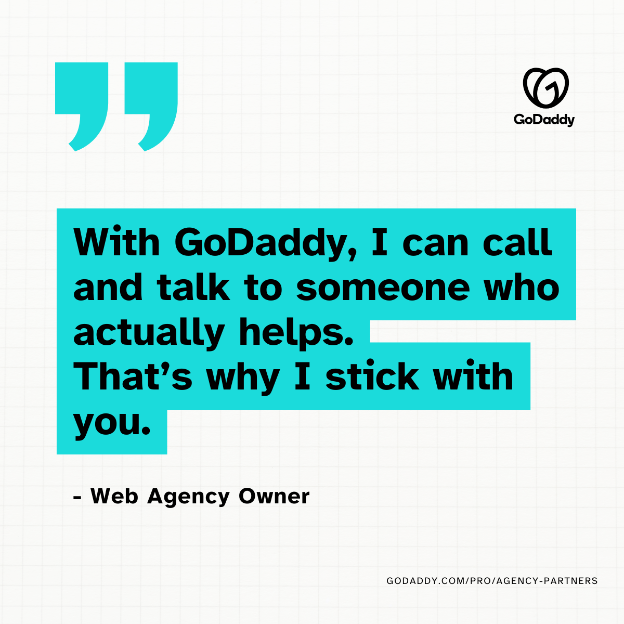
One pro put it plainly:
Another added:
“Clients don’t understand tech. They just want to know someone has their back. Support is part of my insurance policy.”
This was a recurring theme. When a site goes down, when email stops working, when DNS misbehaves, or when a plugin breaks a checkout flow, Pros feel the pressure immediately because their reputation is on the line.
They don’t want to open a ticket and wait. They don’t want to read documentation in a crisis. They want a human who understands the issue and can help them resolve it immediately.
How this connects to GoDaddy
This is precisely why GoDaddy continues to invest heavily in:
- 24/7, U.S.-based human support
- Pro-first workflows and tools designed for multi-client management
- High-performance hosting engineered for real-world WordPress sites
- Infrastructure that reduces load times, improves uptime, and simplifies troubleshooting
This year, those investments paid off in a major way—not just through customer feedback, but through third-party validation.

For Pros, that performance isn’t an optional luxury, it’s a business expectation. They’re building sites for clients who want immediate load times, smooth user experiences, and uptime they never have to think about.
And when something does go wrong, they need a partner who helps them resolve it, not a platform that pushes them into a chatbot loop or a ticket queue.
Takeaway: Choose tools that deliver fast, stable, predictable outcomes. Speed, support, and reliability are the foundation of client trust, and the foundation of your agency’s growth.
When your tools help you deliver consistently great results, you spend less time firefighting and more time building relationships, solving higher-value problems, and scaling your business with confidence.
5. Client acquisition is still the hardest part for everyone
No matter how long someone had been in the business — six months or 16 years — every freelancer and agency owner shared the same challenge:
Finding a steady, predictable flow of clients is the single hardest part of running an agency.
Pros can master design, development, SEO, or branding, but the pipeline problem remains universal. Most people enter the industry because they love the craft… not because they love marketing themselves.
Across our interviews, client acquisition came from the same core channels:
- Freelancer platforms (an essential entry point for many)
- Referrals (the most trusted but the least predictable)
- Networking (local business groups, chambers, community events)
- Agencies hiring contractors (steady but often low-margin)
- Organic search (when Pros have time to invest in their own SEO)
- Social media (mixed results: high effort, inconsistent payoff)
But regardless of channel, the emotional experience was consistent. Pros often feel like they should be doing more to generate leads, but few feel confident they’re doing it the “right” way.
One freelancer shared a sentiment that echoed:
“Upwork is how I meet clients. We do a few projects there, then move off the platform because both sides want to avoid extra fees.”
Another described the challenge more bluntly:
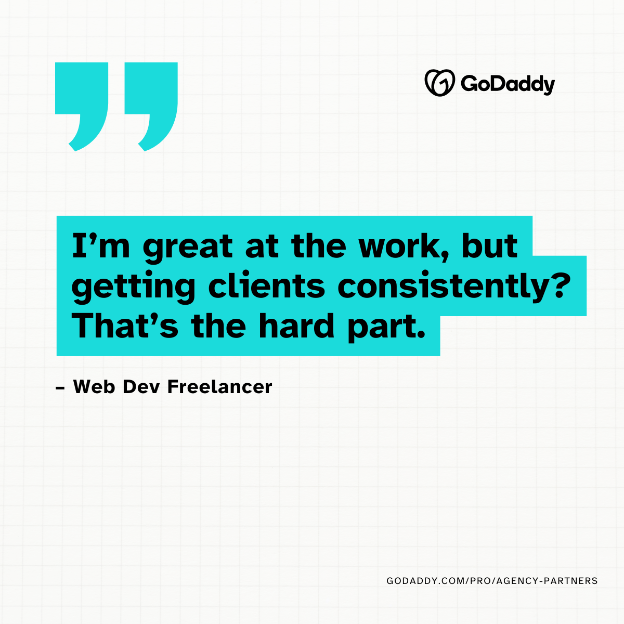
This doesn’t mean that skills are lacking. Rather, it’s a lack of time, clarity, and dependable systems. When you’re building sites, writing content, fixing bugs, handling revisions, and keeping clients happy, lead generation becomes the task that always gets pushed to “next week.”
Why this matters for agencies
Because client acquisition is such a universal struggle, it’s also one of the most important places where GoDaddy can create real, lasting value.
This is a core reason we built, and continue to invest in, the GoDaddy Agency Partner Program.
The program is designed to give agencies:
- More support
- More insights (including research like what you’re reading here)
- More visibility
- More opportunities to connect with potential clients
From sharing market insights, to highlighting high-performing agencies, to creating pathways that help GoDaddy customers discover trusted partners, the Agency Program is designed to give Pros a larger platform — one they don’t have to build alone.
Our goal is simple:
Help agencies grow by connecting them to knowledge, tools, and opportunities they can’t get anywhere else.
Takeaway: Client acquisition is the great equalizer.
The pipeline challenge is real and persistent, no matter if you’re a first-year freelancer or a seasoned agency leader.
Anything that helps Pros get found, get noticed, and get hired fuels the long-term health of the entire industry. And through the GoDaddy Agency Partner Program, we’re committed to helping agencies turn inconsistent opportunities into sustainable growth.
6. AI is becoming an invisible productivity tool
If you only looked at headlines this year, you might think AI is replacing designers and developers.
But that’s not what freelancers and agency owners told us. For real-world Pros, AI isn’t taking the wheel, it’s riding shotgun.
Most professionals aren’t using AI to build entire websites or fully automate creative work. Instead, AI has become a quiet, behind-the-scenes accelerator that helps them work faster, troubleshoot smarter, and spend more time on high-impact tasks.
Across conversations, Pros consistently mentioned using AI for:
- Debugging odd WordPress errors
- Speeding up copywriting and content drafts
- Catching grammar mistakes
- Generating ideas for marketing and email campaigns
- Structuring proposals and onboarding workflows
- Simplifying research or technical explanations
- Producing quick code snippets (HTML, CSS, JS, PHP)
- Planning site architecture or UX flows
Even those who claimed they “don’t really use AI” quickly admitted:
“I mostly use it for grammar checks or polishing content.”
And on the more technical end of the spectrum, AI is already reducing low-level work:
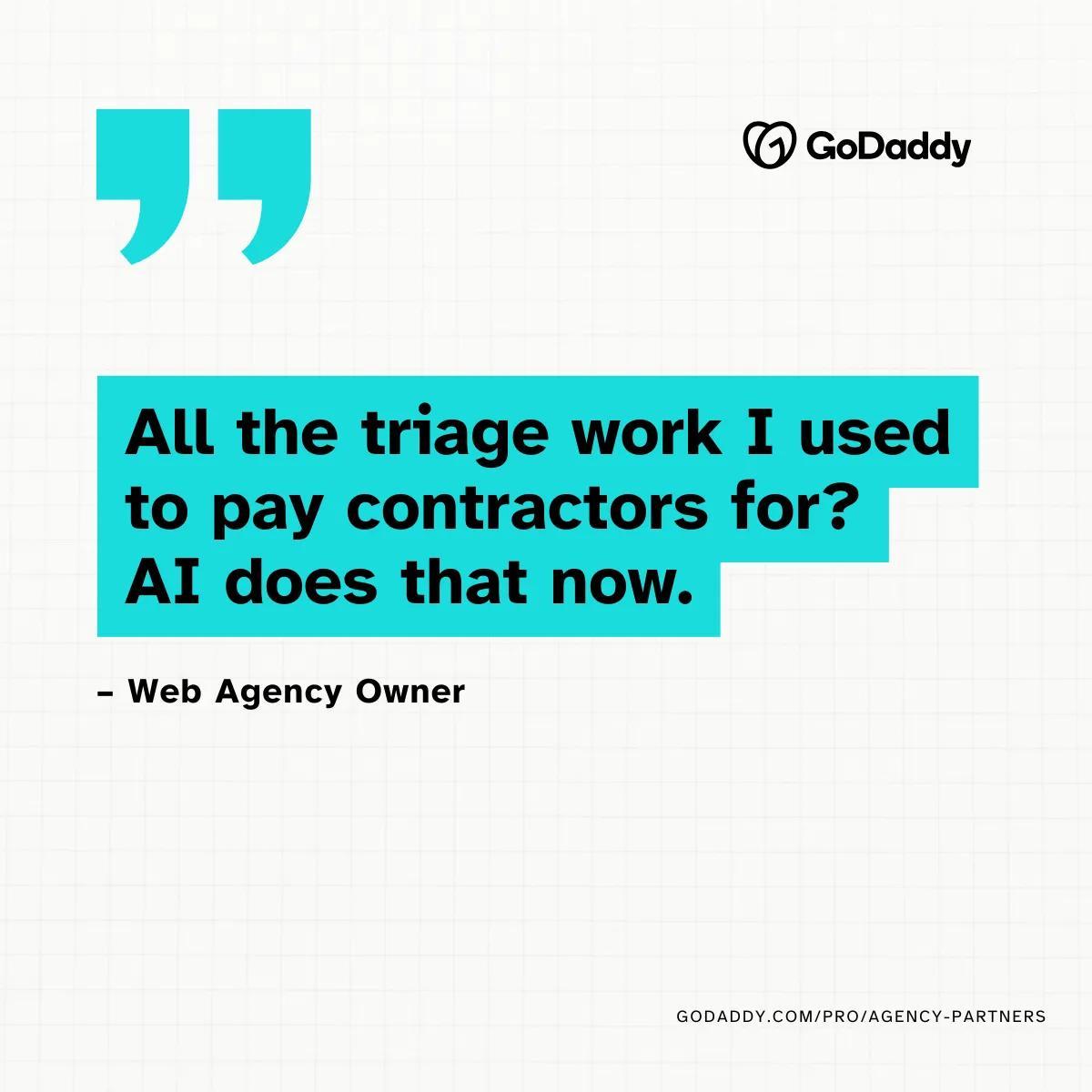
What unites these two ends of the spectrum is simple: Pros aren’t replacing themselves with AI; they’re replacing inefficiency and redundancy.
They’re using AI to clear bottlenecks, improve speed, and remove the tedious parts of the job so they can focus on what clients truly value: creativity, strategy, and business impact.
Why this matters for GoDaddy
Pros don’t want AI to do the job for them. They want it to make the job easier. This is why GoDaddy is investing in AI features that are:
- Assistive rather than automated
- Opt-in rather than intrusive
- Designed to enhance human creativity
- Built around real use cases Pros surfaced in these interviews
From content suggestions to performance insights to workflow automation inside the Hub, our focus is on using AI to:
- Eliminate repetitive tasks
- Reduce manual work
- Solve problems faster
- Help Pros deliver more value in less time
These tools aren’t meant to replace the professional, but empower them instead.
GoDaddy’s Airo® for WordPress is designed to help individuals and agencies build and launch sites in minutes. All with the original WordPress experience intact. So once Airo builds the first version of the website, you can take over and continue with your website design process all from the same WordPress native dashboard.
If you are in the client acquisition phase, you can use Airo for WordPress to build quick mockups to show your client some reference designs. This can significantly reduce the initial workload while Airo does the heavy lifting.
Takeaway: AI isn’t transforming agencies by replacing humans. It’s transforming agencies by freeing humans up to do their best work.
The Pros who thrive in 2026 won’t be the ones who fear AI or the ones who try to automate everything. They’ll be the ones who treat AI like a powerful creative assistant that helps them build smarter, faster, and with more confidence.
7. The most successful pros are the ones with streamlined processes
If there’s one pattern that separated freelancers from fully formed agencies this year, it wasn’t revenue, team size, or location.
The real dividing line is operational maturity.
Freelancers do the work. Agencies build the systems that do the work.
Over and over again, the Pros who grew the fastest — those with consistent income, higher project rates, and the ability to take time off — weren’t necessarily the most talented designers or the most technical developers.
They were the ones who learned how to design and build:
- Repeatable workflows
- Scalable processes
- Predictable systems
- Clear handoff steps
- Standardized tools
- Templates for everything
This evolution is often quiet and gradual, but unmistakable. It starts when a freelancer notices they’re spending too much time answering the same email, rewriting the same proposal, rebuilding the same layout, or troubleshooting the same issues across different clients. Then something clicks.
“If I can streamline this, I can do more work in less time — or bring someone in to help me scale.”
This is the moment the freelancer becomes an emerging agency.
What streamlined pros actually do
Across interviews, the high-performing Pros all shared similar habits:
- Designing in Figma first to reduce rework
- Using one-day website frameworks to accelerate builds
- Standardizing a small set of tools (Elementor, Bricks, Gutenberg, etc.)
- Creating proposal templates, intake forms, and SOPs
- Systematizing onboarding and communication
- Building starter sites or component libraries
- Bundling ongoing services into simple monthly plans
One agency owner summarized the payoff:
“Once you start getting more established, you build out the SOPs and then it’s just more like routine than anything else.”
Another explained how process enables pricing differentiation:
“For premium clients, we design in Figma, then build in Bricks. For budget clients, we build directly in WordPress.”
In both cases, the magic isn’t the tool, it’s the repeatability.
The core lesson: Systems build agencies
Every freelancer eventually hits a ceiling. There are only so many hours in the day, and only so many clients one person can juggle.
But the agency owners you interviewed all described the same turning point. They stopped trying to “work harder” and learned how to “work systematically.”
They documented, templated, automated, delegated, and refined. They built a machine that could support:
- higher volume
- better margins
- consistent quality
- the ability to hire
- the ability to take days off
- the ability to grow without burning out
And that’s what ultimately separates a freelancer who’s stuck from one who grows into a thriving, scalable agency.
Takeaway: Tools matter, but processes matter far more.
The fastest-growing Pros of 2025 didn’t settle for only building great websites, they also built great systems. And those systems became the foundation of their success, their profitability, and their ability to grow from solo operators into agencies with real momentum.
8. Predictable pricing matters — a lot
Pricing came up in nearly every conversation this year. Not just as a business tactic, but as a point of stress for freelancers and agencies at every stage.
Across all levels of experience, Pros consistently expressed frustration with tools and platforms that introduce surprise fees, plugin renewals, complex add-ons, or unpredictable hosting costs.
One Pro said what many echoed:
“Don’t make me buy eight plugins for something that should be built-in.”
This wasn’t about money. It was about:
- Avoiding awkward conversations with clients
- Being able to price projects confidently
- Preventing unexpected costs from eating into margins
- Providing simple, clear proposals that clients understand
- Building predictable recurring revenue in their own agency
And while every Pro had their own project rates, retainers, and billing models, what they valued most was simplicity. They wanted:
- Simple plans they could explain in one sentence
- Transparent pricing without hidden upsells
- Hosting renewals that didn’t surprise their clients
- Bundled functionality that reduced the need for scattered tools
And importantly, they wanted products and services they could mark up confidently, without worrying that a client would find a confusing line item and question their pricing.
This was especially true for newer freelancers who were still building confidence in their value. Tools with confusing or unpredictable pricing reinforced imposter syndrome; tools with clean, simple, predictable pricing gave them the stability to charge what their expertise is actually worth.
Where GoDaddy helps
Predictable pricing is a growth enabler. And it’s an area where GoDaddy is intentionally focused on supporting Pros.
Across our hosting, security, and email services, our goal is to offer:
- Clear and transparent pricing structures
- Easy-to-understand bundles
- Renewals that don’t surprise clients
- Products that agencies can confidently resell
- Management tools (like the Hub) that reduce tool sprawl
This matters because agencies want to spend their time on client work, not decoding pricing tables, tracking plugin renewal dates, or explaining surprise charges their clients found online.
Predictability helps them:
- Price projects clearly
- Build recurring revenue
- Increase client trust
- Reduce operational overhead
- Standardize their service offerings
And the more predictable pricing becomes, the easier it is for Pros to run profitable, stable, and scalable businesses.
Takeaway: Pricing clarity builds trust, and trust builds retention. Retention builds recurring revenue, and recurring revenue builds healthy agencies.
By offering simple, transparent, and agency-friendly pricing across our products and the GoDaddy ecosystem, we aim to make it easier for Pros to focus on what matters most: delivering amazing work, not worrying about unexpected costs.
9. Most Pros are generalists, but those who specialize are accelerating faster
Across all of our interviews conducted this year, most freelancers and studios described themselves the same way:
“I’ll work with anyone who needs help.”
Generalists truly do work with everyone: restaurants, nonprofits, SaaS companies, real estate agents, salons, and fitness coaches. And for many Pros, especially early in their careers, this flexibility is a strength. It brings in revenue, builds a portfolio, and keeps the business active.
But a smaller group of Pros took a different path. They chose a segment, industry, or problem space and went all-in. The difference in their results was dramatic.
One agency owner shared:
“We’re creating a second brand just for sports facilities — it helps us get in more easily.”
Another Pro explained that niching gave them not just clarity, but confidence:
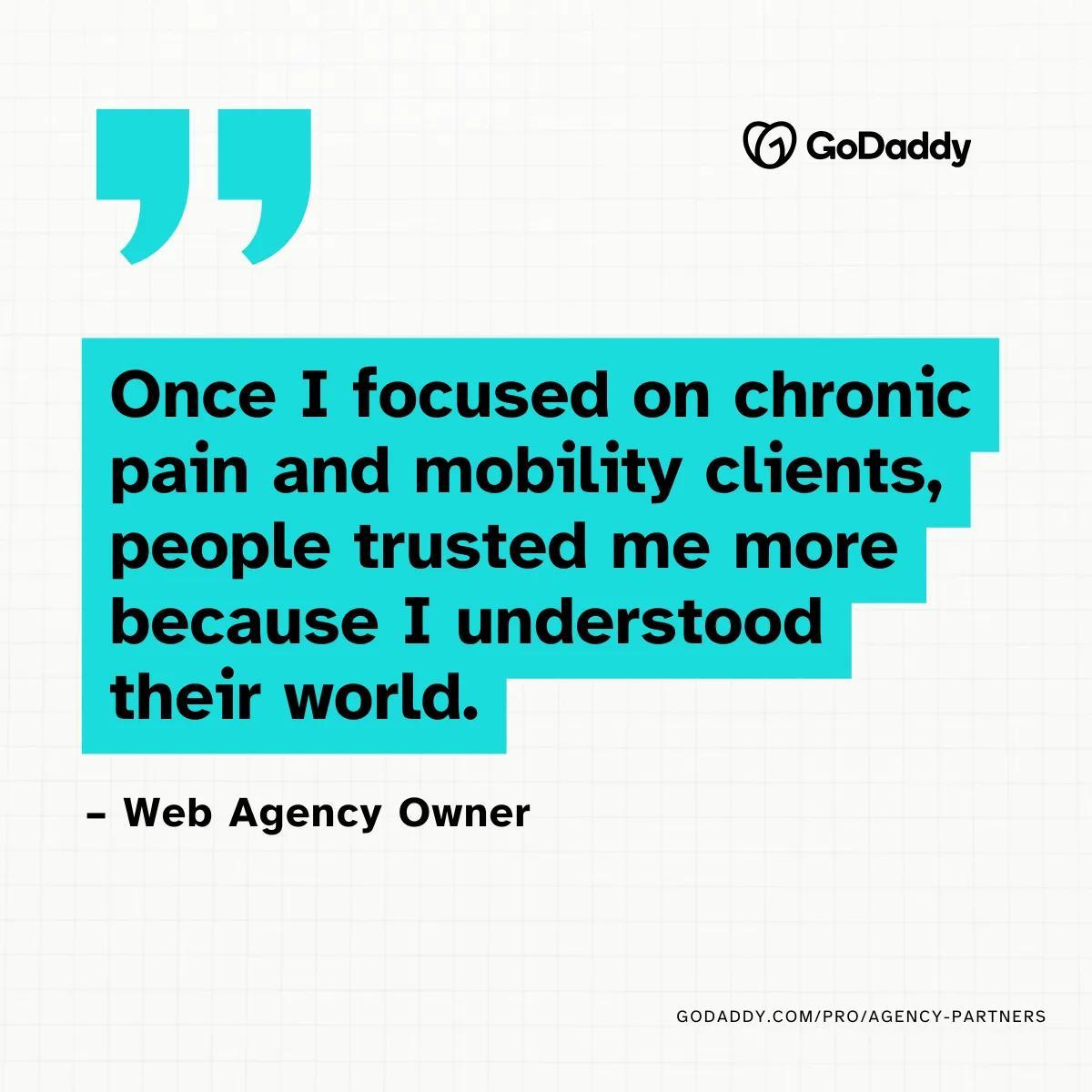
These weren’t isolated cases either. This pattern aligned almost perfectly with what we saw in broader market data.
What the research shows: Specialists grow faster and earn more
To help us understand the digital agency landscape, GoDaddy partnered with Promethean Research. In their “How Digital Agencies Grow” report, Promethean quantified what we consistently heard in our interviews.
According to the report:
- 80% of agencies specialize by service mix
- 59% specialize by industry
- 49% specialize by both
And the performance gap between specialists and generalists is substantial:
- Agencies that specialize by both service and industry have 17% higher average client lifetime revenue
- Those same agencies grow 40% faster than average agencies — even in difficult years
Why? Because specialization makes everything easier. Here’s how:
1. It’s easier to build trust
Promethean notes that specialists “understand both the unique challenges and vocabulary” of their target market.
This accelerates relationship-building, one of the most important drivers of agency growth.
2. It’s easier to nurture leads
Specialists create more relevant content, case studies, and insights, which keeps prospects engaged.
3. It’s easier to expand accounts
Specialists can take what they learn from one client and apply it to others in the same industry, building credibility fast. Promethean put it simply:
“These factors play a major role in why specialists were able to grow so much faster than average during a rough 2023.”
What this means for today’s freelancers and studios
Most Pros don’t begin as specialists, and that’s okay. The journey typically looks like this:
- Start as a generalist to learn the craft
- Notice a pattern in the clients you enjoy most
- Realize those clients refer more work
- Build deeper expertise in a specific space
- Position yourself as the go-to expert for that niche
- Raise prices because clients see you as a specialist
You don’t have to niche immediately. And you don’t have to commit to the same niche forever.
But even partial specialization creates predictability, authority, and higher-margin work.
Pros who specialize often report:
- Less time selling
- Higher close rates
- More referrals
- Fewer difficult clients
- Greater clarity in their marketing
- More confidence in pricing
In short, specialists don’t look for clients as often — clients find them.
Why this matters for GoDaddy
Specialization creates stronger, more sustainable businesses. The GoDaddy Agency Partner Program is designed to support this evolution by:
- Giving agencies a larger platform to showcase their niche expertise
- Helping them get discovered by GoDaddy customers needing specialized skills
- Providing research, insights, and community connections that help clarify their positioning
- Offering tools (like the Hub) that streamline workflows so agencies can focus on higher-value strategic work
- Elevating specialists through badges, tiers, and visibility opportunities
Our goal is to help freelancers and studios transition into specialized, high-performing agencies, without having to navigate the journey alone.
Takeaway: Generalists survive. Specialists scale.
The most successful agencies of the last several years chose a lane, understood it deeply, and became invaluable to the clients in it. With both real-world interviews and industry-wide research pointing to the same conclusion, the message is clear:
Finding your niche isn’t limiting, it’s liberating.
And through the GoDaddy Agency Partner Program, we’re here to support that evolution every step of the way.
10. Pros don’t want to be “website people.” They want to be trusted advisors
If there is one major philosophical shift happening across the industry, it’s this:
Freelancers and agencies don’t want to be seen as “the website person” anymore. They want to be their clients’ go-to advisor for digital growth.
Pros want the opportunity to help their clients:
- Refine their messaging
- Understand their customers
- Structure their services
- Build lead generation systems
- Make smarter marketing decisions
- Choose the right tools
- Improve performance and SEO
- Optimize conversion
- Plan long-term digital strategy
The website is no longer the final deliverable, it’s the starting point.
One Pro summarized this mindset perfectly:
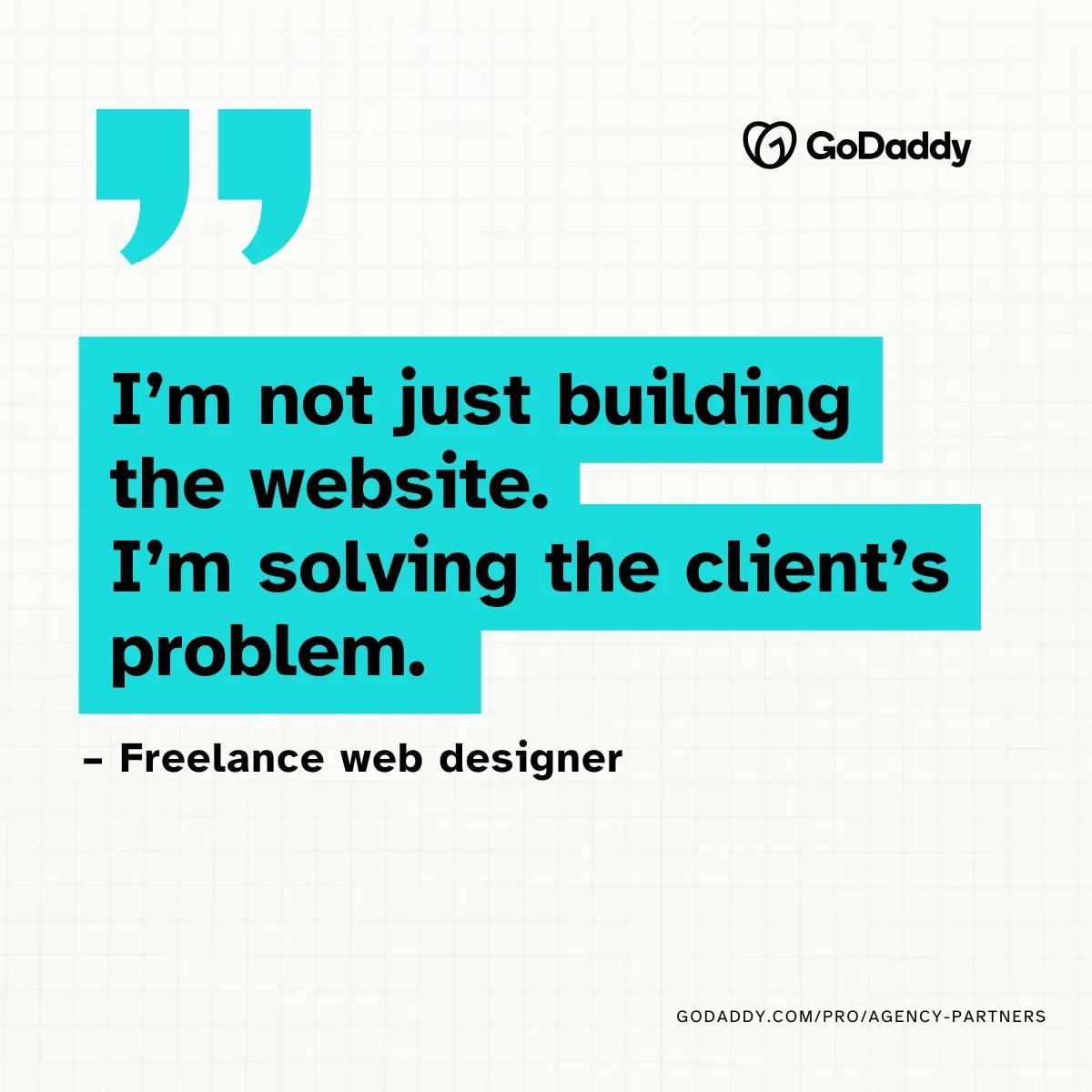
Another Pro described site building as “just the entry point into a long-term consulting relationship.”
This shift matches what Promethean Research has seen across top-performing agencies. According to their findings, agencies that behave as strategic partners rather than technical executors grow significantly faster because:
- Clients stick longer
- Retainers are easier to justify
- Service expansion is seamless
- Agencies become part of business decisions, not just tech decisions
Specialization feeds into this as well: when an agency understands a niche deeply, clients naturally rely on them for broader guidance, rather than merely implementation.
What’s driving this shift?
Several market forces are pushing Pros to step into a more advisory role:
1. Clients are overwhelmed by the complexity of the digital ecosystem
Between SEO, content, paid media, local search, AI, CRM tools, analytics, and funnel strategy… most SMBs feel lost. They don’t want a technician, they need a guide.
2. Technology has become more accessible
With visual builders, templates, AI tools, and low-code platforms, clients know they could build something themselves. What they can’t do on their own is make smart, strategic decisions. That’s where Pros add irreplaceable value.
3. Recurring revenue models reward strategic leadership
Retainers shouldn’t be thought of as only for updates. They’re also for insight, direction, and ongoing improvement.
4. Pros themselves want more fulfilling work
Many said some version of:
- “I’m tired of being the person who just takes orders and fixes things.”
- “I want to help clients grow, not just build what they ask for.”
- “I’m more valuable as a strategic partner.”
This desire for deeper impact is reshaping what it means to be a web designer or web developer.
Why this matters for GoDaddy
GoDaddy’s mission in the Pro ecosystem is to empower digital professionals to move up the value chain. That’s why we’re building:
1. The GoDaddy Agency Partner Program
Designed to help Pros:
- Elevate their credibility
- Get visibility with GoDaddy customers
- Access deeper insights (like this report)
- Connect with higher-quality clients
- Strengthen their business positioning
Agencies in the program are consultants, strategists, and trusted partners. And our goal is to amplify that.
2. The Hub by GoDaddy Pro
A centralized place where Pros can:
- Monitor client sites
- Manage updates
- Automate tasks
- Run performance checks
- Streamline communication
This frees up time and mental space for Pros to focus on strategy, not firefighting.
3. AI-powered insights and automation
AI tools are not to replace the Pro, but to make it easier to deliver smart, meaningful recommendations that reinforce their value as advisors.
Takeaway: The future of the digital professional isn’t only about building websites. Pros are building business outcomes entirely.
The Pros who stand out in 2026 won’t be the ones who churn out the most pages or the fanciest animations. They’ll be the ones who:
- Understand their clients deeply
- Guide them with clarity and confidence
- Bring data-driven insights
- Take a seat at the strategy table
- Focus on long-term partnerships
- Use tools and AI to enhance their expertise
Digital Pros are becoming strategic partners. Their value is no longer in what they build, but in the clarity and growth they help clients achieve.
And through GoDaddy’s Pro ecosystem and the Agency Partner Program, we’re committed to helping every freelancer and agency owner unlock that next level.
Final thoughts: 2025 was a year of reinvention
If there’s one word that captures what we heard across hundreds of conversations this year, it’s reinvention:
- Freelancers reinvented themselves into agencies.
- Designers reinvented themselves into strategists.
- Developers reinvented their workflows with AI.
- Generalists reinvented their positioning by niching down.
- Agencies reinvented their business models around recurring revenue.
- And almost everyone reinvented how they learn, build, grow, and serve their clients.
What stood out most wasn’t the speed of change in the industry, it was the resilience and creativity of the people in it. Pros showed us again and again that success isn’t about having the perfect process, or the perfect tool stack, or the perfect origin story.
It’s about being willing to evolve: to keep learning, building, and showing up for clients who rely on you.
And that’s exactly why GoDaddy continues to invest in the tools, insights, programs, and community that help digital professionals do their best work. Whether through the Hub, our Managed hosting for WordPress platform, the Site Maintenance Packs, or the GoDaddy Agency Partner Program, our mission is simple:
To help freelancers and agencies build stronger businesses and to grow with them every step of the way.
This series is the start of a broader effort to share what we’re seeing in the market: the trends, patterns, challenges, and opportunities shaping the future of digital work. Over the next several weeks, we’ll dive deeper into each of the ten themes we uncovered in 2025 and explore how Pros can apply these insights to their own business in 2026.
Want to learn more? Join the insiders in the GoDaddy Pro Facebook community, run by the team that collected these insights. We share everything we learn about the industry in this community of digital professionals and ask for feedback about how GoDaddy can improve the experience for web professionals.