


Ready to get your business started in Utah? Let’s explore how to start an LLC in Utah step by step, from naming your business to registering it, and what to expect in your first year.
Utah is built for people who like to make things happen. It’s home to fast-growing tech hubs, thriving small businesses, and an entrepreneurial culture that values independence and momentum. If you’re ready to turn your big idea into something official, forming an LLC in Utah is a great place to begin. If you’re comparing options in nearby states, learn how to form an LLC in Colorado.
How to start an LLC in Utah in 5 steps
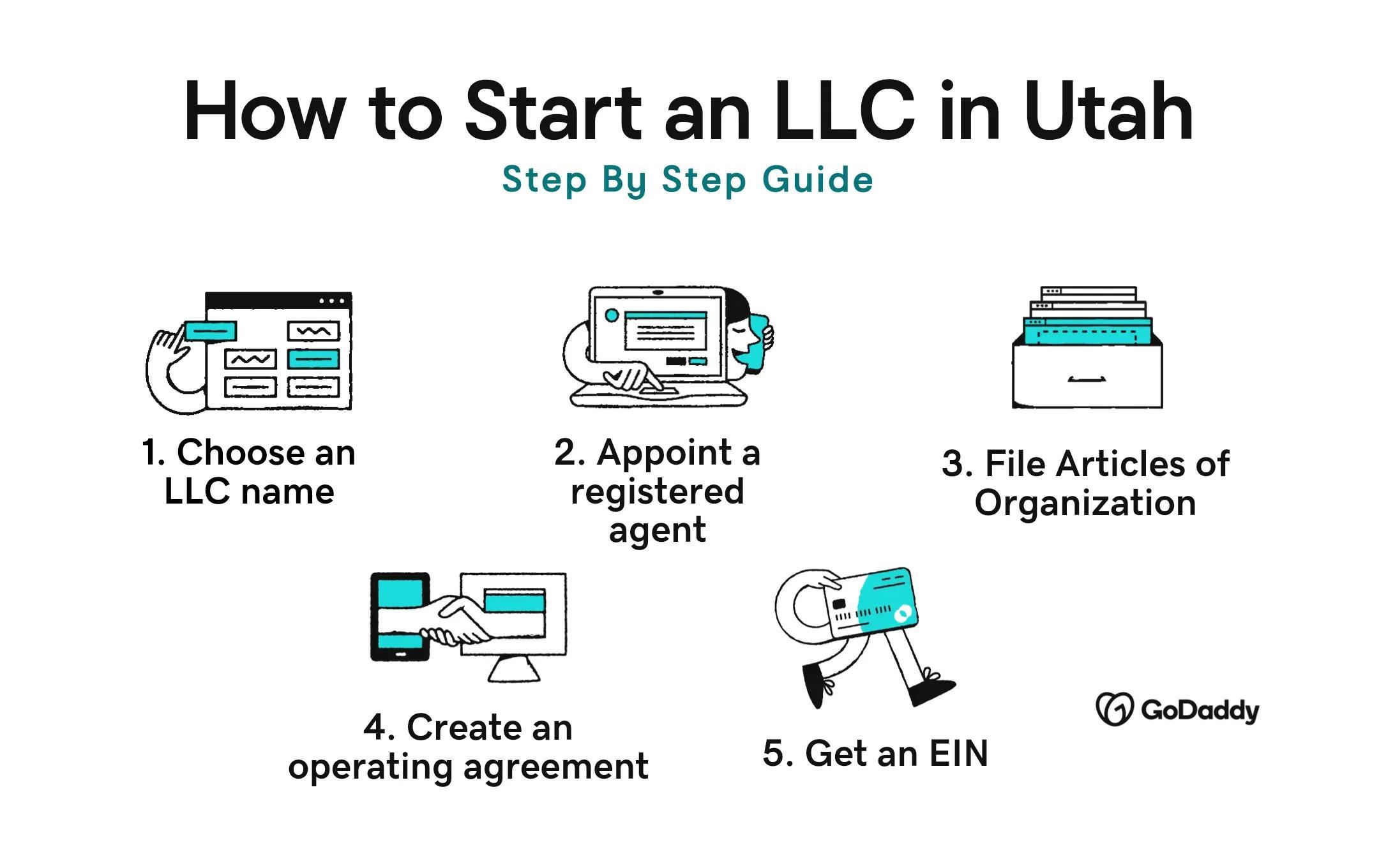
To open an LLC in Utah, you need to choose a business name, appoint a registered agent, file a Certificate of Organization with the state, create an operating agreement, and apply for an EIN. While it may look like a lot at first glance, Utah keeps the process efficient. If you file online through the Utah business portal, many business owners can complete these steps in just a few business days.
If this is your first time starting a business, you may want to read these guides to LLC VS LLP and sole proprietorship VS LLC. Once you’ve done your research and are ready to launch, set up your LLC for free with GoDaddy.
1. Choose a name for your LLC
The first step in your journey is to choose an available name for your new LLC that fits your brand and meets state requirements. Your business name sets the tone for how customers see you, so it should be clear, memorable, and ready to grow with you. The Utah Division of Corporations and Commercial Code requires that your LLC name:
- Includes “Limited Liability Company” or an accepted abbreviation such as “LLC” or “L.L.C.”
- Is distinguishable from other business names already registered in Utah
- Does not suggest a connection to a government agency, including terms like “Treasury” or “State Department”
- Avoids restricted words such as “bank” or “insurance” unless proper approval is granted
Once you have a name in mind, check availability using the Utah business entity search. Utah allows you to reserve a name for 120 days for $22 if you want to secure it before filing.
Get your business domain name
After choosing your LLC name, locking in a matching domain helps protect your brand online and makes it easier for customers to find you. This adds credibility from day one and keeps your name consistent across channels.
Get a DBA
A ‘Doing Business As” (DBA), commonly called an assumed name in Utah, allows your Utah LLC to operate under a different name than its legal business name. For example, “Salt Lake Ventures LLC” could register an assumed name to do business as “SLV Outdoor Co.” Assumed names can be filed with the Utah Division of Corporations and Commercial Code for $22. They must be renewed every three years.
Unsure how an assumed name can benefit your business? Check out this article explaining what is a DBA.
2. Appoint a registered agent
Every LLC in Utah must designate a registered agent to receive legal documents and official notices on the business's behalf. They help keep your LLC in good standing and ensure that important communications from the state or the courts are handled properly. In Utah, a registered agent must:
- Have a physical street address in Utah, not a P.O. box
- Be available during normal business hours
You can name yourself, another member, or manager, or any individual who meets these requirements. Many business owners choose a professional registered agent service to maintain privacy and avoid missing time-sensitive paperwork. Learn more on what is a registered agent in this article.
3. File Certificate of Organization
For the state to recognize your Utah LLC, you must file a Certificate of Organization with the Division of Corporations and Commercial Code. You will need to provide:
- Your LLC’s name and principal office address
- The name and physical address of your registered agent
- The name and signature of the organizer
The filing fee for a Utah LLC is $59. Most filings are processed within a few business days. Once your Certificate of Organization is approved, your Utah LLC is officially registered and ready to move forward.
4. Create an operating agreement
Utah does not require LLCs to file an operating agreement with the state, but having one is a good idea. An operating agreement outlines how your LLC will be run, helps reinforce your limited liability protection, and reduces the risk of disputes between members. Many banks and lenders also ask for a copy before opening a business account or approving financing.
An effective operating agreement typically covers:
- Roles and responsibilities of members and managers
- Ownership percentages
- How profits and losses are distributed
- Voting rights and decision-making procedures
- Rules for adding or removing members
- Meeting and recordkeeping expectations
- Dissolution terms if the LLC closes
Even if you are forming a single-member LLC, an operating agreement adds credibility and clearly separates you from the business as a legal entity. Read our “What is an operating agreement” guide to find out how to write one that supports your Utah LLC.
5. Get an EIN
An Employer Identification Number, or EIN, is a federal tax ID issued by the IRS. Most Utah LLCs need an EIN to handle key business tasks, including:
- Filing federal and state taxes
- Hiring employees
- Opening a business bank account
- Applying for licenses or permits
You can apply for an EIN through the IRS website. If you’re not sure what tax IDs your Utah LLC needs, read about TIN vs EIN.
How long does it take to get an EIN?
When you apply online, you typically receive your EIN immediately. Applications submitted by mail or fax can take a few weeks to process.
How much does an EIN cost?
Applying for an EIN is free. The IRS does not charge application, processing, or renewal fees.
Types of LLCs available in Utah
Utah offers several types of LLCs to support different business models, missions, and expansion plans. Understanding the options helps you choose a structure that aligns with how and where you plan to operate.
- Domestic LLC: Formed in Utah and operating primarily within the state. This is the most common choice for local businesses.
- Foreign LLC: An LLC formed in another state that registers to do business in Utah.
- Professional LLC (foreign and domestic): Designed for licensed professionals who offer services such as legal or medical work.
- Series LLC (foreign and domestic): Allows multiple divisions under one LLC, each with separate assets and liabilities.
- Low-profit LLC: Built for mission-driven businesses that prioritize social impact alongside profit.
- Benefit LLC: Combines profit goals with a legal commitment to public or environmental benefit.
How much does it cost to start and run an LLC in Utah
Utah keeps LLC costs fairly reasonable. While exact expenses depend on your business setup, here are the common costs to plan for:
- Certificate of Organization: $59 when filed online
- Name reservation (optional): $22 to reserve a name for up to 120 days
- Assumed name registration (optional): $22 per name
- Registered agent service (optional): Typically $50–$150 per year
- Annual renewal: $23, due each year to keep your LLC in good standing
- Business licenses and permits: Vary by industry and city
- Taxes: Utah does not have a separate LLC tax, but LLCs pay federal income tax and any applicable Utah income, employer, or sales taxes
Most business owners can expect to spend roughly $59–$300 to form and maintain a Utah LLC during the first year, depending on optional services and licensing needs.
What happens after your LLC is up and running
Forming your Utah limited liability company is exciting, but there are a few ongoing tasks you should be aware of to help keep your business compliant and your LLC protections intact.
Open a business bank account
Setting up a separate bank account for your Utah LLC helps keep personal and business finances clearly divided. This supports your liability protection, simplifies bookkeeping, and makes your business look more credible to customers and lenders. Most banks will ask for:
- Your business address
- Your Certificate of Organization
- Your EIN from the IRS
- Your operating agreement
- A valid photo ID for all account holders
- An initial deposit
File for permits and required business licenses
Utah does not issue a single statewide business license, but many businesses need licenses or permits at the state, city, or county level. Requirements vary based on your industry and location. To find what applies to your LLC:
- Review state-level requirements through Utah’s Division of Professional Licensing
- Check with your city or county for local business licenses
- Confirm any federal licensing rules if your business operates in regulated industries
File annual reports
Every Utah LLC must file an annual renewal (also called an annual report) to remain in good standing. This filing confirms your business information and keeps your registration active.
- Deadline: Each year by the anniversary date of your LLC’s formation
- Filing fee: $23
- How to file: Online through the Utah Division of Corporations and Commercial Code
Missing the deadline can result in late fees or administrative dissolution, so it is worth adding this task to your calendar. Need more information? Find more on the LLC annual report in this guide.
Other things to consider for your Utah LLC
Before jumping into day-to-day operations, there are a few more things you need to understand about running a Utah LLC.
Filing state taxes for Utah LLCs
Utah does not have a separate LLC tax, but your business may still have state and federal tax responsibilities. How you file business taxes for LLCs depends on how your LLC is structured and taxed. Common obligations include:
- Federal income tax: Single-member LLCs typically report income on a personal tax return, while multi-member LLCs file as partnerships unless another tax election is made.
- Utah income tax: Utah has a flat individual and corporate income tax rate, which may apply depending on how your LLC is taxed.
- Sales tax: Businesses selling taxable goods or services must register to collect Utah sales tax, with rates that vary by location.
- Employer taxes: If you have employees, you must register with the Utah State Tax Commission and the Department of Workforce Services for payroll and unemployment taxes.
Get a Certificate of Existence (Good Standing)
A Certificate of Existence, also known as a Certificate of Good Standing, confirms that your Utah LLC is active and up to date with state requirements. You may need this document when:
- Opening a business bank account
- Applying for financing
- Registering your LLC in another state
- Working with investors or partners
You can request a Certificate of Existence through the Division of Corporations and Commercial Code portal for $12. If you need a long-form Certificate of Existence, the fee is $20.
When it's a good idea to start an LLC in Utah
Forming an LLC in Utah makes sense for many business owners thanks to the state’s streamlined filing process and supportive business climate. It can be a strong move if your goals line up with these advantages:
- You want liability protection while keeping your business structure flexible and easy to manage
- You plan to operate in Utah or serve customers along the Wasatch Front, in fast-growing cities, or statewide
- You prefer predictable costs, with low filing fees and a simple annual renewal process
- You are starting a small business, side hustle, or startup, and want room to grow without heavy compliance requirements
- You value a business-friendly environment with a growing economy and access to a skilled workforce
Ready to get your venture off the ground? Set up your LLC for free with GoDaddy today!
FAQ
What is a Utah foreign LLC?
A Utah foreign LLC is a limited liability company formed in another state that is registered to do business in Utah. This registration allows the LLC to legally operate in Utah while keeping its original state of formation.
What are the benefits of an LLC in Utah?
An LLC in Utah offers liability protection, flexible management options, and relatively low startup and maintenance costs. Utah’s efficient filing system and growing business environment make it appealing for both small businesses and expanding companies.
How long does it take to get an LLC in Utah?
If you file online, many Utah LLCs are approved within a few business days. Processing times can vary depending on filing volume.
Does Utah tax LLCs?
Utah does not have a separate LLC tax, but LLC income may be subject to federal and Utah income taxes. LLCs may also need to collect sales tax or pay employer taxes, depending on their circumstances.