
If you've ever thought, “there should be an app for that,” 2026 might be the year you finally build it. This list rounds up 25 app ideas across productivity, local community, fintech, lifestyle, and local business.
Our guide is curated for entrepreneurs, side-hustlers, and small business owners who want to launch something real without a technical co-founder or a six-figure budget. AI and no-code tools have collapsed the distance between “I have an idea” and “I have a working app,” turning what used to be a months-long build into something you can prototype in an afternoon.
If you're curious about the opportunity AI is creating for small business owners, it's worth reading about AI-powered business opportunities and the fundamentals of starting a business before you dive in.
Now, let's get into the ideas.
What makes a good app idea in 2026?
Not every idea is worth building, and the best ones in 2026 tend to share three traits.
First, they solve a specific, narrow pain point instead of trying to be everything to everyone — a booking tool for mobile dog groomers will outperform a generic services app every time.
Second, they lean into hyper-personalization or hyper-local focus, serving one neighborhood, one niche hobby, or one type of business exceptionally well, rather than a broad market adequately.
Third, the strongest ideas combine several fragmented tools or workflows — spreadsheets, texts, sticky notes, three different apps — into one intuitive experience.
Before you commit weeks to building anything, it's worth testing whether real people actually want it. Talking to five potential users beats guessing every time.
Local business and service app ideas
Local service businesses remain one of the most under-built, highest-ROI categories in software. Salons, restaurants, and home service pros are often still running on paper, spreadsheets, or phone tag — meaning a well-built booking and scheduling platform or dispatch tool can win a loyal customer base fast.
1. Beauty and wellness booking hub
What it is: A booking and scheduling platform for salons, estheticians, and wellness studios.
Why it works: It replaces phone-tag scheduling with self-serve booking, payments, and reminders. Who it's for: Independent studios and multi-stylist salons.
How to build it: Online booking calendar, integrated payments, automated reminders, and staff schedules — a wellness booking platform that feels custom to each studio's brand.
2. Restaurant reservation and pre-order app
What it is: A reservation and pre-order tool built specifically for independent restaurants.
Why it works: Diners increasingly expect to reserve tables and order ahead, but many independent spots still rely on phone calls.
Who it's for: Owner-operated restaurants and small chains.
How to build it: Table reservations, a pre-order menu, and an admin panel for restaurant reservations so staff can manage seating and orders from one screen. You can create a restaurant website with AI and launch this quickly without coding.
3. Home services quote and dispatch app
What it is: A quoting and job-dispatch tool for plumbers, electricians, landscapers, and cleaners.
Why it works: It turns calls into instant quotes and visible scheduling. Who it's for: Small home service crews juggling multiple jobs a day.
How to build it: A quote request form, job scheduling, route optimization, and a customer dashboard showing job status in real time.
GoDaddy Airo AI Builder
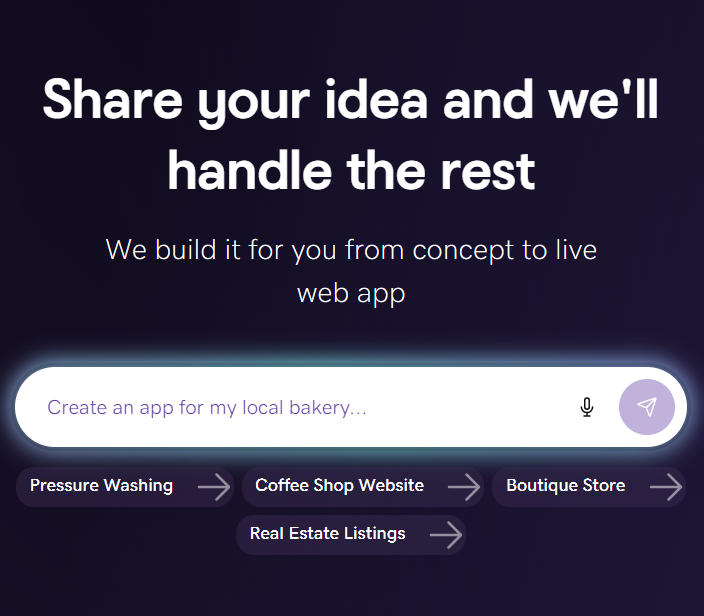
Describe your idea. We'll build your live website in minutes.
With a few prompts, Airo AI Builder generates your website, web app, pages, databases and logic in minutes — no coding required. Start for free with 50 AI credits a month. No credit card required.
Build for FreeSMB productivity app ideas
AI is unlocking real-time savings for small teams — giving a two-person shop the operational muscle of a much bigger company, without the hiring.
4. Invoice chase assistant
What it is: A tool that automatically follows up on overdue invoices.
Why it works: Chasing payment is awkward and time-consuming, so it often gets skipped — which hurts cash flow.
Who it's for: Freelancers and small agencies.
How to build it: Customizable email/SMS sequences, payment status tracking, and a simple dashboard of who owes what.
5. Proposal generator
What it is: A tool that turns a short brief into a branded, client-ready proposal.
Why it works: Proposals are repetitive but high-stakes; automating the formatting frees up time for the actual pitch.
Who it's for: Consultants, agencies, and contractors.
How to build it: A short intake form, templated pricing/scope/terms sections, and one-click branded export.
6. Meeting-to-action tracker
What it is: A tool that transcribes meetings and turns them into summaries and assigned tasks.
Why it works: Most action items die in a notes app; this frees up the follow-through and keeps everyone accountable.
Who it's for: Small teams and managers who run back-to-back client calls.
How to build it: Auto-transcription, AI-generated summaries, and action items pushed straight to calendars and task lists.
7. SOP and staff training hub
What it is: A tool where owners document processes — by voice or notes — that AI turns into structured SOPs and a searchable training assistant.
Why it works: Institutional knowledge usually lives in one person's head; this gets it out and makes onboarding repeatable.
Who it's for: Small business owners hiring their first few employees.
How to build it: Voice-to-text capture, AI formatting into step-by-step guides, and a searchable Q&A layer for new hires.
8. Recruiting pipeline assistant
What it is: A lightweight applicant tracker built for businesses without an HR department.
Why it works: Hiring often happens over email threads and sticky notes; this brings structure without enterprise overhead.
Who it's for: Small business owners and solo managers hiring occasionally.
How to build it: An applicant dashboard, interview scheduling, and AI-drafted candidate messages.
9. Client follow-up assistant
What it is: A tool that tracks client touchpoints and suggests next-step messages.
Why it works: Leads go cold fast when follow-up is manual and inconsistent.
Who it's for: Freelancers, agencies, and small sales teams.
How to build it: A contact timeline, automated reminders, and AI-suggested outreach copy.
Notice a theme? Nearly every idea in this section is really a custom database with a workflow and a friendly interface wrapped around it — exactly the kind of app AI builders are made to handle.
FinTech and creator economy app ideas
Money management and content creation are colliding, and both freelancers and creators are underserved by generic finance apps and one-size-fits-all platforms.
10. Gamified budgeting and savings app
What it is: A budgeting tool that turns saving into reward-based challenges and streaks.
Why it works: Gamification keeps people engaged with money habits longer than a static spreadsheet.
Who it's for: Younger savers and habit-driven users.
How to build it: Manual or linked balance tracking, streak counters, and milestone rewards.
11. Subscription management dashboard
What it is: A central place to log subscriptions — streaming, SaaS, gym, and more — to see spending in one view.
Why it works: Subscription creep is invisible until someone adds it all up.
Who it's for: Households and solo professionals juggling recurring charges.
How to build it: A manual entry log, renewal-date reminders, and a spending-by-category view.
12. Freelancer client portal and invoicing hub
What it is: A branded portal for project tracking, document signing, and invoicing.
Why it works: It replaces email chaos with one professional hub clients trust.
Who it's for: Freelancers and small agencies.
How to build it: Project timelines, e-signature requests, and invoicing tied to a payment processor like Stripe or Square.
13. Cash flow forecaster for freelancers
What it is: A tool that predicts income gaps based on invoice timing and recurring expenses.
Why it works: Irregular income makes planning hard; forecasting ahead prevents surprises.
Who it's for: Freelancers and contractors with variable pay cycles.
How to build it: Invoice and expense inputs, a rolling forecast view, and low-balance alerts.
14. Freelance rate calculator
What it is: A calculator where freelancers input experience, location, and niche to get a recommended rate.
Why it works: Pricing is one of the hardest parts of freelancing, and data beats guesswork.
Who it's for: New and mid-career freelancers.
How to build it: A short questionnaire, a benchmarking dataset, and a clear hourly/project output.
15. Creator monetization platform
What it is: Tools for creators to sell digital products, memberships, or accept tips directly.
Why it works: Creators are tired of splitting revenue with big platforms.
Who it's for: Independent creators, newsletter writers, and educators.
How to build it: A storefront, membership tiers, and payment integration via Stripe or Square.
If this is your niche, you're not the only one building in this space — it pays to validate the idea first before investing heavily, and a custom domain will matter a lot here since it's the difference between just another creator page and a brand people subscribe to and trust.
16. Content repurposing tool
What it is: A tool that turns one video or podcast into platform-optimized posts, newsletter snippets, and short-form scripts.
Why it works: Creators know repurposing works, but rarely have time to do it manually.
Who it's for: Podcasters, YouTubers, and solo content creators.
How to build it: Transcript extraction, AI rewriting per platform format, and an export/scheduling view.
Niche and local community app ideas
Niche and hyper-local apps are some of the most underserved — and most lucrative — opportunities out there. Small audiences mean less competition, and tight communities create deep loyalty and strong word-of-mouth growth.
17. Hyper-local food rescue app
What it is: A directory-style app connecting local bakeries and grocers with nearby residents to sell surplus food at the end of the day.
Why it works: It reduces waste while giving budget-conscious shoppers a deal.
Who it's for: Independent food retailers and local residents.
How to build it: A listing of daily surplus items, pickup windows, and simple in-app payment.
18. Niche hobby swap marketplace
What it is: A localized marketplace for specific communities — plant cuttings, board games, vinyl records.
Why it works: Niche collectors want a trusted space, not a generic classifieds site.
Who it's for: Hobbyist communities with an active trading culture.
How to build it: A listing/directory of items, direct messaging, and optional local meetup coordination.
19. Accessibility mapper
What it is: A crowdsourced directory of accessible spaces in a city — think quiet hours at stores, step-free entrances, service-animal-friendly venues, or low-sensory shopping windows.
Why it works: People with varying needs rely on word-of-mouth today; a shared map scales that knowledge.
Who it's for: Residents and visitors navigating unfamiliar areas.
How to build it: A map interface, user-submitted listings, and a moderation/admin panel to verify submissions before they go live.
20. Neighborhood tool and equipment lending library
What it is: An app for neighbors to lend and borrow tools, ladders, or pressure washers.
Why it works: Most tools sit unused most of the year; sharing saves money for everyone.
Who it's for: Residential neighborhoods and community groups.
How to build it: A listing/directory of available items, a booking calendar for pickup, and a simple rating system.
21. Community-powered local discovery platform
What it is: A locals-only recommendation platform for restaurants, events, and hidden gems.
Why it works: Locals trust neighbors over algorithm-driven review sites.
Who it's for: Tight-knit towns and neighborhoods.
How to build it: A content platform for submitted recommendations, tagging by category, and community upvotes.
A quick but important note: any neighborhood directory, discovery platform, or accessibility mapper that stores user-submitted content or location data should have clear consent flows, moderation rules, and a basic understanding of local privacy regulations before launch. This protects both contributors and the people they're writing about.
If your app idea is growing into a real community, it's also worth exploring strategies for building a social media team to help manage engagement as it scales.
Habit and lifestyle app ideas
Habit and lifestyle apps help people track and organize their routines — they're tools for structure, not sources of medical, mental health, or fitness advice.
22. Habit optimizer
What it is: A tool that analyzes daily routines and suggests small, two-minute windows for building new habits.
Why it works: Small, scheduled nudges are easier to stick with than vague goals.
Who it's for: Anyone trying to build consistency around a new routine.
How to build it: A routine input log, pattern tracking, and gentle scheduling suggestions.
23. Focus session planner
What it is: A tool that blocks distractions and schedules deep-work sprints.
Why it works: Time-blocking with built-in accountability beats an open-ended to-do list.
Who it's for: Remote workers, students, and freelancers.
How to build it: Session scheduling, a distraction-block timer, and simple output tracking per session.
24. Predictive pantry planner
What it is: A tool that scans fridge and pantry contents and suggests recipes from what's on hand.
Why it works: It cuts food waste and takes the guesswork out of mealtime.
Who it's for: Households, meal preppers, or a niche audience like a local grocer's customers or people managing specific dietary restrictions.
How to build it: A manual or photo-based inventory log, a recipe-matching engine, and a shopping list generator.
If you're building this for a specific niche — say, a regional grocery chain or a gluten-free community — know you're not the only one thinking this way; it's worth validating the idea early, and pairing it with a custom domain so the app reads as a trustworthy, standalone brand rather than a generic template.
25. Pet care and reminder passport
What it is: A tracker for vaccination logs, vet appointments, weight tracking, and local pet-care needs.
Why it works: Pet records are scattered across paper folders and vet offices; centralizing them keeps owners organized and ready for emergencies.
Who it's for: Pet owners, and potentially local pet-care businesses looking to offer a branded tool to clients.
How to build it: A record log for vaccinations and vet visits, appointment reminders, and a weight/health tracker over time.
Build your app idea with GoDaddy Airo AI Builder
Here's the good news: you don't need to hire a developer or learn to code to bring any of these 25 ideas to life. GoDaddy Airo AI Builder turns your app idea into a real, production-ready app in minutes — just describe what you want, and AI builds it.
No coding, no learning curve.
That's the core of it, but it's worth breaking down what that actually means.
First, Airo AI Builder creates real apps you can launch, not just clickable prototypes or design mockups — what you build is production-ready from day one.
Second, everything you need lives in one place: hosting, a custom domain, business email, a database, payments, security, marketing tools, and analytics are all bundled together instead of stitched across five different vendors.
Third, it's designed to scale. You can go from testing an MVP with real users to running a full business on the same platform, with no painful migration to a real tech stack once you outgrow the free version.
If you can describe your idea in a sentence, you can build it — the entire creation process is conversational.
And what comes out the other end doesn't look like a hobby project; it looks professional, modern, and secure, which matters the moment you're asking real customers to book, pay, or sign up.
What kind of apps can you build with Airo Builder?
Airo AI Builder is especially strong for the kinds of ideas covered in this article — practical, vertical-specific tools for real businesses and creators, including:
- Home services: Booking and dispatch apps, quote calculators, customer dashboards
- Beauty and wellness: Appointment booking with integrated payments, staff schedules, member portals
- Restaurants and food services: Reservations, online ordering, and menu management
- Professional services: Client portals, intake forms, scheduling tools, and custom calculators
- Real estate, insurance, and financial pros: Custom calculators, intake apps, and quote tools
- Coaches, consultants, and educators: Customer portals, course delivery, and member-only content
- Retailers and creators: Product catalogs, ordering workflows, and monetization tools
Whether you're a solo entrepreneur validating your first idea or a small business owner ready to replace a patchwork of spreadsheets and sticky notes, Airo meets you where you are — and grows with you as your app idea turns into an actual business with actual customers.
Ready to see your idea as a working app? Start building with GoDaddy Airo AI Builder.
Turn your app idea into reality
Every idea on this list drew from similar inspiration: a specific, persistent problem that nobody had solved well yet. The businesses that win in 2026 won't necessarily have the biggest budgets.
They'll be the ones who moved first, built something real, and iterated based on actual customer feedback instead of guesswork.
So pick the idea from this list that matches a problem you actually understand — your neighborhood, your industry, your community — and start small. Describe it, build it, launch it, and let real users tell you what to build next.