
Somewhere in the world, right now, someone is naming an idea.
It might be a bakery in Lisbon. An AI startup in San Francisco. A small business owner in Mumbai turning a weekend side hustle into something bigger. Before any of it becomes real, one thing has to happen first: they need a domain name.
That's where we come in.
For more than 25 years, GoDaddy has had the pleasure of being there for that moment. Today, over 20 million customers in more than 100 countries trust us to help them claim their corner of the internet - which means that when we look at our proprietary data, we're not just looking at GoDaddy. We're looking at a meaningful slice of the open web itself.
So once a year, we step back and ask a simple question: what is the world actually building?
In this blog post, we’ll cover the full answer. It's a story about domain names, geography, language, ambition, and taste. About the enduring power of .com, the breakout of .ai, and a handful of shifts we didn't see coming. And more than anything, it's a thank-you — genuinely — to every single person who decided 2025 was their year to start something new, and trusted GoDaddy to help them register a domain and bring it to life.
.com is still the anchor. But the story is getting richer.
Let's start with the number that barely moved and the one that shifted the most.
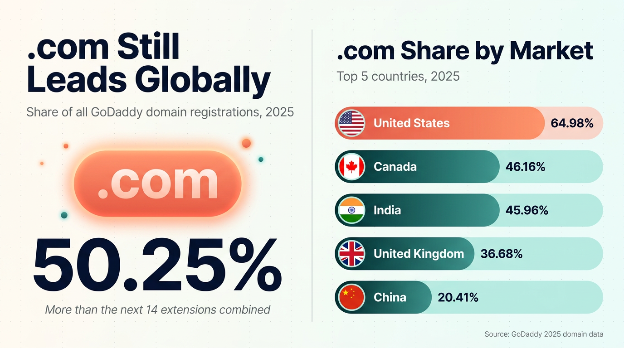
In 2025, .com accounted for 50.25% of every domain registered on GoDaddy. More than the next fourteen extensions combined. Four decades in, three letters still carry remarkable trust.
Look across our major markets, though, and the picture gets more textured:
- 🇺🇸 United States - 64.98% .com
- 🇨🇦 Canada - 46.16%
- 🇮🇳 India - 45.96%
- 🇬🇧 United Kingdom - 36.68%
- 🇨🇳 China - 20.41%
In the U.S., customers who register a domain still reach for .com almost by reflex. In other markets, customers are thoughtfully building a mix, blending .com with local or specialty extensions that reflect where they are and what they do.
Five countries, most of our registrations
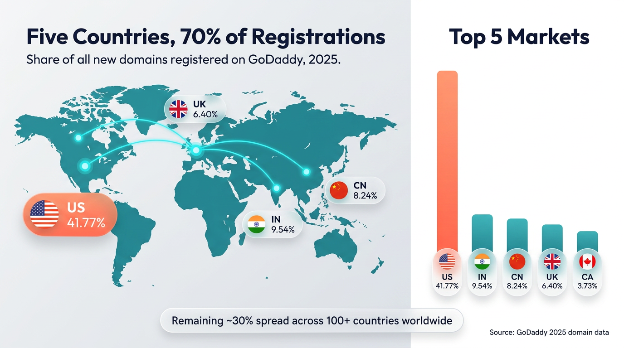
On GoDaddy, the domain market is more concentrated than you might expect. In 2025, nearly 70% of the new domains registered with us came from just five countries, with the U.S. leading at 41.77% of all GoDaddy registrations.
| Rank | Country | Share of GoDaddy 2025 registrations |
|---|---|---|
| 1 | 🇺🇸 United States | 41.77% |
| 2 | 🇮🇳 India | 9.54% |
| 3 | 🇨🇳 China | 8.24% |
| 4 | 🇬🇧 United Kingdom | 6.40% |
| 5 | 🇨🇦 Canada | 3.73% |
A closer look at the U.S.
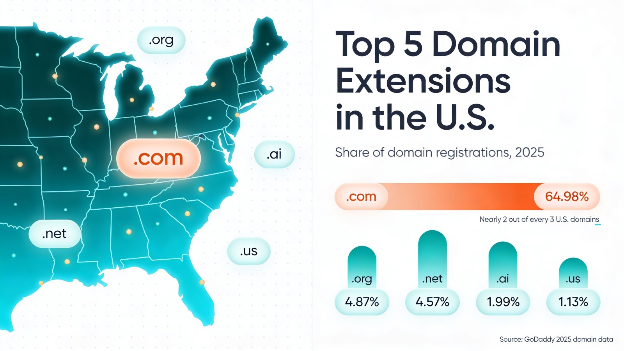
Since the United States drives over 40% of global registrations, it's worth taking a closer look at what American business owners are actually choosing.
Here’s a quick breakdown of the top five domain extensions registered in the United States:
Two things stand out.
First, .com's grip on the U.S. is unmatched. Nearly two out of every three American customers who register a domain on GoDaddy still reach for .com.
Second, .ai has cracked the top five. An extension that wasn't on anyone's radar three years ago now outranks .us in the U.S.
Outside the U.S., local extensions shine
If you're building a business beyond American borders, here's a pattern worth planning around: one .com is often not the full picture.
In the UK, .co.uk nearly matches .com among GoDaddy customers at 35.89%. Add .uk, and more than four in ten UK registrations are local extensions.
In India, .in alone accounts for 24.91% of GoDaddy registrations. Include .co.in, and close to one in three Indian domains on GoDaddy is a local ccTLD.
In Canada, .ca sits at 34.78% of Canadian registrations, about a third of the market. The takeaway is practical. Customers in these markets often want to see a local extension, and search engines reward the signal. If you're expanding internationally, pairing your .com with a local ccTLD when you buy a domain is one of the simplest ways to build trust with local audiences.
The breakout story of 2025: .ai
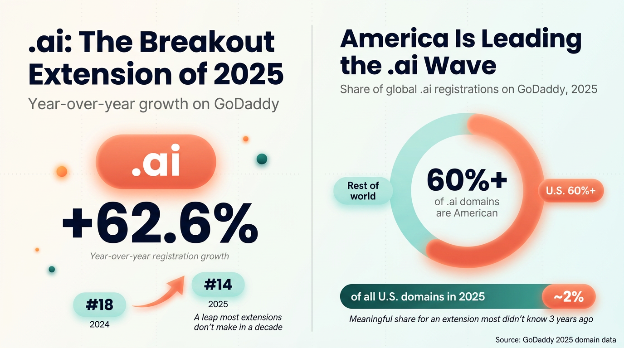
Every year has an extension that defines it. In our 2025 data, that extension was .ai.
On GoDaddy, .ai registrations grew 62.6% year-over-year. In our rankings, it climbed from #18 to #14 in a single year.
And the growth wasn't powered by a handful of large buyers. Total registrations and daily averages grew at nearly identical rates, which tells us this demand came from thousands of individual founders and teams, each making the same choice independently.
The U.S. led the way. More than 60% of .ai domains registered on GoDaddy came from American customers. Nearly 2% of every U.S. domain registered on GoDaddy in 2025 was a .ai, a meaningful share for an extension that most people didn't really use three years ago. The signal is simple: if you're building something in AI, .ai proves credibility. You can find your .ai domain on GoDaddy in seconds.
Ecommerce has its own lane
A few years ago, telling someone your domain ended in .shop might have sounded experimental. Not in 2025.
In 2025, .shop became the #4 extension on GoDaddy globally, at 2.82% of all registrations. .store landed at #11 with 1.93%. Together, they represent millions of merchants who decided the fastest way to tell a customer what they do is to put it right there in the URL. If you're starting an online business and the .com you want is already taken, a .shop or .store isn't a compromise. It's a clear, confident signal of what you sell.
The internet has a favorite day
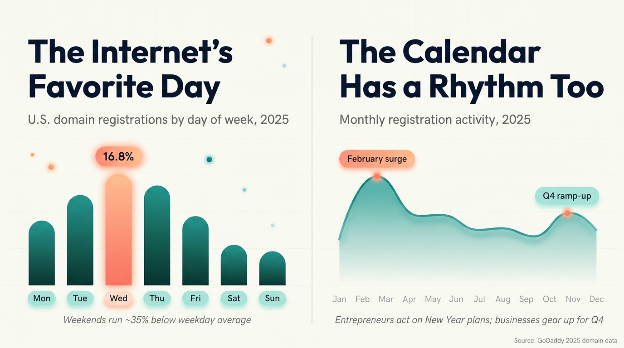
Wednesday is the busiest day for domain registrations on GoDaddy.
In 2025, 16.8% of every U.S. domain registration on GoDaddy happened on a Wednesday. Weekends run about 35% below the weekday average. The calendar has its own pattern too: February surges as entrepreneurs act on New Year plans, and mid-November picks up as businesses gear up for Q4.
So if you're sitting on a name you love, don't leave it for Saturday. Wednesday mornings are when the internet moves fastest, and the name you want today is likely the name someone else is searching for right now.
What 2025 is telling us about 2026
Here’s what the cumulative stats tell us about domain trends in 2026:
- .com is still the anchor. Trusted, instinctive, and still more than half of GoDaddy registrations.
- Local extensions matter more than ever. If you sell beyond the U.S., pairing your .com with a ccTLD is often a smart move.
- .ai has graduated. No longer a tech flex. If you’re building in AI, you need a .ai domain.
- Ecommerce extensions are credible. .shop and .store have earned their place.
- Timing is an advantage. The best moment to find a domain name and lock it in is midweek, before demand peaks.
The domain landscape heading into 2026 is more diverse, more global, and more thoughtful than it has ever been. That's the good news for anyone starting something new: there have never been more ways to plant your flag online.
The hardest part is just deciding to begin.
Your name is out there
Much of the internet has been built by people willing to name something new.
Somewhere in our 2025 proprietary data is a founder who registered a domain on an ordinary Wednesday in February and changed the trajectory of their life. In 2026, that could be you.
If you have an idea, a business, or a brand still waiting on a name, this is the moment. Find and register your domain on GoDaddy in minutes, and join the 20+ million customers already building what's next.
GoDaddy customers registered millions of domains in 2025. The only one that matters for you is the one you haven't registered yet.