
Knowing what you’ll pay to accept a card shouldn’t be complicated. GoDaddy Payments keeps it simple with a flat rate for each payment channel, regardless of the card your customer uses. Helcim takes a different approach with its interchange-plus pricing where they add a published markup to card-network costs that vary by transaction. Both make their pricing clear, but in different ways. The choice comes down to whether you prefer a predictable rate or a breakdown of the costs behind each payment.
- GoDaddy Payments offers simple flat-rate pricing for in-person transactions at 2.5% + 0¢, or a discounted 2.3% + 0¢ with the Point of Sale Plus plan so merchants can forecast costs without fixed per-transaction fees or card-type surprises.
- Helcim, in contrast, uses interchange-plus pricing, where you see exactly what you’re paying for, but the final cost can fluctuate based on card type, network fees, transaction size, and processing volume.
Compare and analyze all features of GoDaddy and Helcim in this article.
GoDaddy Payments vs Helcim feature comparison
| Factor | GoDaddy (Payments + POS) | Helcim (Payments + POS) |
|---|---|---|
| Pricing model | Simple Flat rate (fixed % + fee per transaction) | Variable Interchange-plus (wholesale cost + margin) |
| In-person rate | 2.5% + 0¢ 2.3% + 0¢ with Plus plan With Point of Sale Plus Rate Saver enabled: credit card: 0% |
Interchange + ~0.40% + 8¢ Example: 2.38%–2.72% + 8¢, by card type ($25 transaction; $25K monthly volume) With Fee Saver enabled: credit card: 0% Debit: standard rates |
| Online/e-commerce rate | 2.9% + 30¢ (2.7% + 30¢ with Plus plan) |
Interchange + ~0.50 + $0.25 Example: 2.89%–3.12% + 25¢, by card type ($25 transaction; $25K monthly volume) |
| Keyed-in/manual entry rate | 3.5% + 0¢ | Interchange + ~0.50 + $0.25 |
| Invoicing rate | 2.9% + 30¢ (2.8% + 30¢ with Plus plan) |
Interchange + ~0.50 + $0.25 |
| ACH transfer fee | 1% (0.8% per transaction (max $10) with a subscription plan) | 0.5% + 25¢, capped at $6, plus an additional 0.05% on amounts over $25,000 |
| Custom rates | Contact Sales to ask about custom rates for your processing profile | Automatic interchange-plus volume tiers apply on a rolling three-month average; Helcim directs merchants processing more than $5 million per month to Sales for custom pricing |
| Monthly software fee | Free Plan: $0 Plus plan: $28.99/mo. |
Free Plan: $0 No additional plans |
| POS hardware | 3 Smart Terminals: Duo $399, Flex $275, Pro $499 Hardware rentals start at $19.99/mo. |
Helcim Smart Terminal at $349 No hardware rental options |
| POS hardware shipping cost | Free | $30+ |
| Shipping time | 2 business days | 3 to 5 business days |
| Deposit speed | Next business day free; Same-day or instant payout for 1.75% fee |
Next-business-morning deposits free; No same-day option |
| Support | 24/7 Phone and Chat Support | Monday to Friday 7 AM to 5 PM Saturday 9 AM to 5 PM |
| Free setup & migration | Yes | No |
| Best fit | Small businesses that want simple and predictable processing rates, free set up and migration, 24*7 phone support and no contract. | Merchants that want payments processing and are comfortable with variable interchange-plus pricing that changes by card type and volume. |
Why pricing predictability and card mix matter
GoDaddy publishes its in-person rate a merchant pays transparently, with a predictable flat rate:
- 2.5% + 0¢ without a plan, or
- 2.3% + 0¢ with Point of Sale Plus ($28.99/month billed annually)
This makes it straightforward to model a typical month: in-person card volume multiplied by the applicable rate, plus the optional Point of Sale Plus subscription if you want additional features and a discounted rate.
Helcim publishes its markup transparently, too, but the merchant’s all-in cost remains variable — the sum of card-network interchange, assessments, network fees, and Helcim’s markup. That is a different form of transparency where merchants get to see exactly what goes into each charge, but making monthly cost less predictable.
Interchange changes are built into interchange-plus pricing
Interchange-plus pricing passes underlying network costs through to the merchant. For example, Mastercard says its interchange rates are typically updated semiannually, and that product type, merchant category, transaction data, and other criteria affect which interchange rate applies. As those underlying inputs change, the all-in interchange-plus cost can change even if the Helcim’s markup stays the same.
Card type mix also changes Helcim’s total effective rate
Helcim passes interchange, assessments, and network fees through, so the economic cost varies by the type of card and transaction that a customer uses. Mastercard’s interchange documentation, for example, organizes rates by product type and qualification criteria. For example, With Helcim, your fees for this month may be higher than last month’s if your customers paid more with reward cards, such as American Express, compared to last month. GoDaddy’s flat rate model does not add a different markup for rewards, business, or other card categories. This can make budgeting simpler for merchants who value predictability and simplicity.
To calculate your effective rate and compare, divide your total processing fees by your total card sales volume for the same period, then multiply by 100. Doing this calculation yourself every month helps you easily monitor how much you're actually paying vs. The listed rates from your payments processor.
Reasons to choose GoDaddy Payments Over Helcim
- You want simple, predictable flat-rate pricing
GoDaddy’s flat-rate pricing model makes payment costs easier to understand across the ways a business accepts payments, whether customers pay in person, online, through invoices, or with keyed-in transactions. Merchants can see the stated rate upfront, avoid unexpected card-type swings, and more easily forecast processing costs across busy sales days, high transaction counts, and lower-ticket purchases.
Helcim’s interchange-plus model can be harder to predict because the final cost can change by card type, interchange rate, network fees, transaction method, transaction size, and processing volume.
- You want zero per transaction pricing
For in-person payments, GoDaddy’s clearest pricing advantage is its $0 per-transaction fee across in-person plans. Merchants don’t pay an added fixed fee every time a customer taps, dips, or swipes a card, which can make a meaningful difference for businesses with frequent transactions or lower average order values. Helcim, by comparison, adds a fixed per-transaction fee on top of its variable interchange-plus pricing.
Compare GoDaddy with more credit card processing companies.
- You want same-day access to funds
GoDaddy deposits arrive as soon as the next business day for free, or same day (including weekends/holidays) for a 1.75% fee.
Helcim offers free next-business-morning deposits but has no same-day option.
- You want a wider range of hardware including countertop options to match your setup
GoDaddy offers four distinct hardware options:
- Single-screen portable Smart Terminal Flex ($275) for simple checkouts
- Dual-screen Smart Terminal Duo ($399) for customer-facing displays
- Large swivel screen Smart Terminal Pro ($499) for large catalogs and complex transactions in a countertop setup.
More reasons to compare Rate Saver and Fee Saver: Compare the customer experience, transaction eligibility, debit treatment, and current program terms, not simply a headline “0%” claim. Both GoDaddy and Helcim uses credit surcharge but treats debit charges differently.
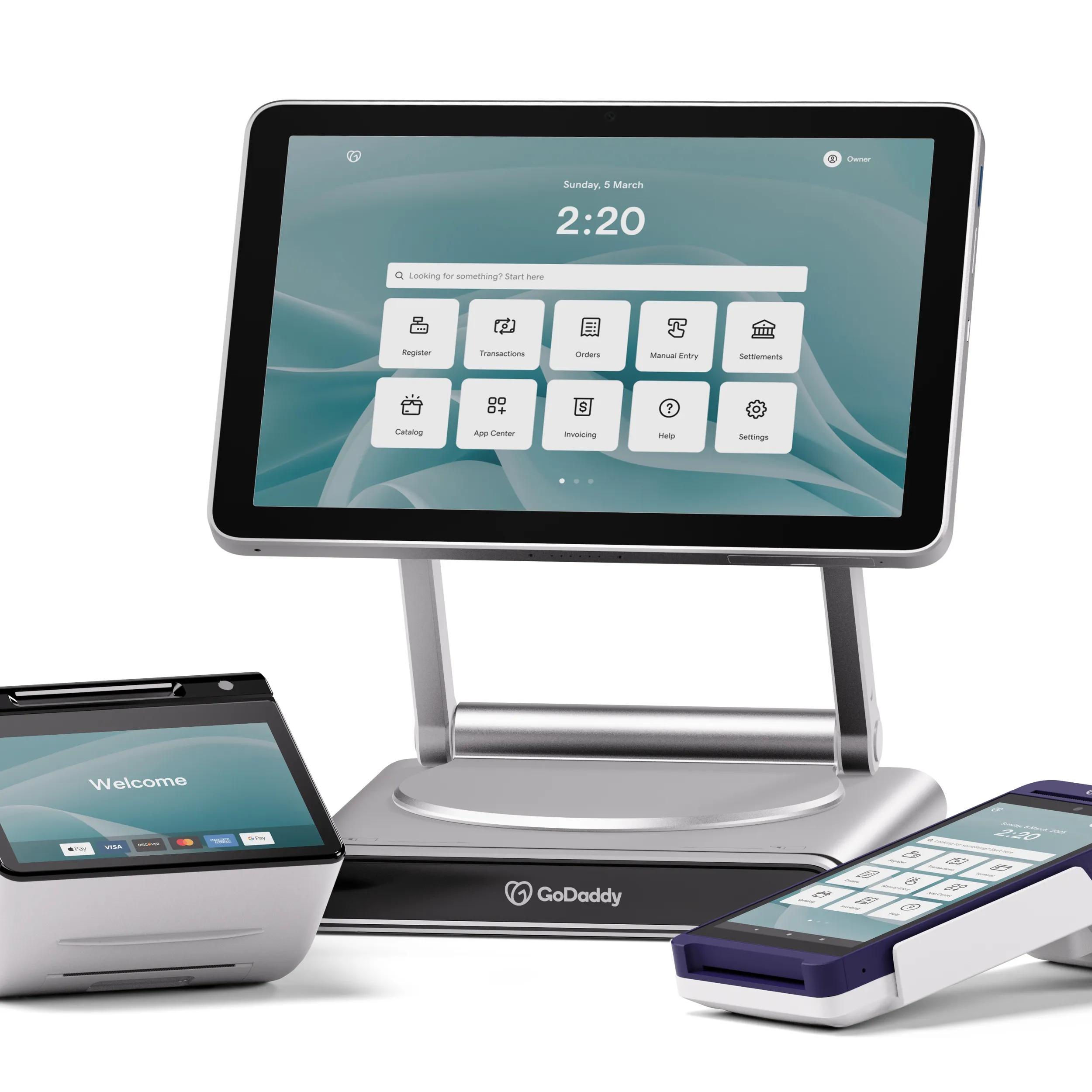
Helcim, by contrast, offers just two hardware options (Smart Terminal at $349 and a Card Reader at $199), and do not have options for customer-facing display or large display. This gives GoDaddy merchants more flexibility to pick hardware sized to their specific store format.
- You want more than payments processing. You want a small business growth ecosystem.
GoDaddy Payments can support in-person payments through GoDaddy POS while also connecting to online selling tools through its AI Website Builder and native WordPress/WooCommerce workflows. Merchants also get access to GoDaddy’s broader family of small business tools, including domains, website builder, invoicing, Pay Links, and GoDaddy Capital.
Helcim is more narrowly focused on payments processing. Its tools cover payment-adjacent needs such as invoicing, recurring payments, virtual terminals, and inventory, but it does not offer the same connected website-building, commerce, funding, and marketing ecosystem.
- You want a low commitment way to get started
GoDaddy has an affordable POS software plan with no monthly fee on the standard plan. GoDaddy POS hardware ships free in 2 days, and purchases come with a 30-day money-back guarantee. Hardware rental options are also available starting at $19.99/mo, making it easier to get started without purchasing equipment upfront.
Helcim software is free with no monthly fee, but the hardware takes 3 to 5 business days and a $30 standard fee for shipping which will be lost when returning the terminal.
- You need advanced POS functionalities such as BOPIS support (Buy Online, Pick Up In-Store)
GoDaddy’s Point of Sale Plus plan, natively supports click-and-collect orders. Customers buy an item on your site, and the software routes an order to your in-store POS terminal, letting employees know to bag it for pickup.
Helcim does not natively bridge an online order tracking screen with the physical POS terminal for workflow management.
Customer story: GoDaddy Point of Sale helps streamline workflows at chiropractor’s office
Learn more
- You want fast, built-in access to working capital
GoDaddy Capital is a merchant cash advance built directly into the commerce dashboard. You can apply in a few clicks with no paperwork, get funded in as little as 24 hours, and repay automatically as a flexible percentage of daily sales (more when sales are strong, less when they're slow). There's no credit score impact, no collateral required, and financing is available for up to $1 million.
Helcim currently offers no equivalent financing or cash-advance product, so merchants who may need quick working capital down the line have one less reason to look elsewhere with GoDaddy.
- You want 24/7 phone support, with complimentary setup and migration.
GoDaddy's customer support team is available by phone around the clock, every day of the week, at no charge, in addition to 24/7 live chat. This gives merchants a reliable option to get help whenever an issue comes up, including nights, weekends, and holidays.
GoDaddy also offers personalized, complimentary setup and migration assistance when switching to GoDaddy Payments, helping merchants move their business over without extra cost or a DIY learning curve.
Helcim's support, by comparison, is limited to phone hours from Monday to Friday 7am to 5pm MT and Saturdays 9am to 5pm MT, with no support coverage on Sundays or outside those windows. This is a meaningful gap for businesses that operate evenings, weekends, or across time zones and may need help outside standard business hours.
Bottom line: Making the right choice
GoDaddy Payments and Helcim both focus on making pricing transparent for the customers, but they’re done in different ways: GoDaddy keeps one flat rate per payment channel, while Helcim shows the markup on top of variable card-network costs. The right choice depends on which kind of clarity matters more to your business.
Why choose GoDaddy
Choose GoDaddy Payments if you want simple and predictable flat-rate processing, so your monthly cost is predictable regardless the type of cards your customers use, with no added fixed per-transaction fee on in-person payments, and a wider choice of POS hardware. You also get better integration into rest of GoDaddy ecosystem, 24/7 phone support, no long-term contract, free setup and migration support.
Why choose Helcim
Choose Helcim if you prefer their interchange-plus pricing that shows the exact interchange fee per transaction with their markups, and receive discounted fees based on your transacting volume rather than a monthly subscription. It suits merchants with high transacting volume where the tiered pricing could be cheaper, since its markup steps down automatically as monthly card volume reaches higher tiers, and those with a lot of PIN debit sales, where its pass-through rates can run lower.
At a glance: best for GoDaddy Payments vs best for Helcim
Use this quick view to match each option to your business. A worked example for each follows the table.
| Best for GoDaddy Payments | Best for Helcim |
|---|---|
| You want one flat rate on every card, so monthly costs are easy to forecast | You want to see each charge broken into interchange plus a published markup (0.40% + 8¢ at Tier 1) |
| You take many small in-person payments and want no fixed per-transaction fee (2.5% or 2.3% + 0¢ with Point of Sale Plus). Or with Rate Saver at 0% in-person credit card fees, and 1.9% + 0¢ | You have a lot of PIN debit sales, where Helcim’s pass-through rates can run lower (1.91% + 8¢ at Tier 1) |
| You want free next-business day payouts with access to same-day/instant funds (1.75% fee) and 24/7 phone and chat support | Next-business-morning deposits and Mon–Sat phone support are enough |
| You want a wider hardware range (Flex, Duo, Pro), rentals from $19.99/mo (or buy outright starting at $275), free shipping, and free setup and migration | You want a single Smart Terminal ($349) or Card Reader ($199) and software with no monthly fee |
| You want more than payments: website, WordPress/WooCommerce, BOPIS, invoicing, Pay Links, and GoDaddy Capital | You want a payments-focused tool set with invoicing, recurring payments, and virtual terminal |
Best by vertical: an example for each
Best for GoDaddy Payments: Businesses with high transaction volume and low ticket sizes. Think coffee shops, bakeries, Retail, and quick-service counters where a typical sale is small and customers pay all day long. GoDaddy’s in-person rates (2.5% + 0¢, or 2.3% + 0¢ with Point of Sale Plus) carry no fixed per-transaction fee, while Helcim adds 8¢ to every card-present transaction at Tier 1. On small tickets, that fixed fee is a bigger share of each sale. A flat rate that stays the same across card types also keeps costs easy to forecast, and 24/7 phone and chat support covers early-morning and weekend shifts.
Best for Helcim: businesses that expect to grow into higher volume tiers. Helcim’s interchange-plus markup steps down as monthly card volume rises, from 0.40% + 8¢ at Tier 1 ($0 to $50K) to 0.35% + 7¢ at Tier 2 ($50K to $100K). Tiers apply automatically on a rolling three-month average, and merchants processing more than $5 million per month can talk to Sales about custom pricing. A growing merchant who is comfortable with variable, card-mix-driven costs and wants its markup to shrink as sales climb may find that path appealing.
Need a workflow that fits your business?
Every business has a few processes that standard software does not cover. If you need a customer portal, a simple staff dashboard, or a workflow made for the way you work, you can create a focused web app with Airo AI Builder or use the tools you already know.
If you already work with a developer or AI coding tools, explore the GoDaddy Commerce API for stores, products, customers, orders, taxes, and transaction data, or the Poynt API for Smart Terminal and POS integrations. Connections depend on the systems, permissions, and review required, so start with the business process you want to improve.
GoDaddy Payments vs Helcim Frequently asked questions
Is GoDaddy Payments cheaper than Helcim?
It depends on your actual card mix, volume, payment channels, and plan needs. GoDaddy publishes flat in-person rates by plan. Helcim publishes a markup that is added to variable interchange, assessments, and network costs.
What is Helcim’s 0.40% + 8¢ rate?
For merchants in Helcim’s Tier 1 volume band, it is the card-present markup. It is not the all-in processing rate because interchange, assessments, and network costs are added.
Does Helcim offer 24/7 phone support?
Helcim’s help center lists phone support Monday–Friday 7 a.m.–5 p.m. MT and Saturday 9 a.m.–5 p.m. MT. Confirm the channels and hours that apply to your account.
Can I use Rate Saver and Helcim Fee Saver in the same way?
Both change the treatment of eligible credit-card costs, but program eligibility, debit treatment, customer experience, and terms differ. Review the current documents for each program before enabling either.
What hardware should I compare with Helcim?
Compare the Smart Terminal checkout workflow you need. GoDaddy offers Smart Terminal Flex, Duo, and Pro; Helcim lists a Smart Terminal. Confirm current purchase, tax, accessory, and support terms.
Does GoDaddy offer free setup and migration support?
Yes. GoDaddy offers free setup and migration support, personalized setup, and 24/7 phone and chat support.
Do I need Point of Sale Plus for GoDaddy’s 2.3% + 0¢ rate?
Yes. The 2.3% + 0¢ in-person rate requires Point of Sale Plus, currently listed at $28.99 per month with an annual plan.
Disclaimer: Pricing and feature information was accurate as of November 4, 2026, but may be subject to change.