
Key takeaways
- Late payments kill your cash flow and create unnecessary stress.
- Setting clear expectations up front prevents most payment problems.
- Multiple payment options = fewer excuses for clients to delay.
- Automation saves you time and often gets you paid faster.
- A few strategic changes can dramatically improve how quickly money hits your account.
Here's what I've learned after years of chasing payments as a freelancer: You have way more control over when you get paid than you think. Let’s explore exactly how to get paid faster as a freelancer, shall we?
Why getting paid faster actually matters
If you're a freelancer or small business owner like me, you’ve likely been on the receiving end of slow payments. Late payments can seriously impact a small business.
The impact of late payments on cash flow
Cash flow determines whether you can buy groceries this week or pay your rent on time.
Early in my freelancing career, I had multiple clients all pay late in the same month. Suddenly, I couldn't cover my own expenses. I had to put rent on a credit card. It was not my finest moment.
The simple fact is that late payments do so much more than annoy you. They can actually put you out of business.
According to one survey, small businesses and entrepreneurs wait an average of 30 days to get paid. Our guide is here to help you speed up the payment process as much as possible so that you can get paid faster.
Step 1: Take immediate actions for individuals and small businesses
Okay, let’s get into the nitty-gritty of how to get paid faster.
Set up direct deposit and early direct deposit
If you're still dealing with paper checks, it’s time to modernize.
Direct deposit gets money to you in 1-3 business days instead of a week or more.
Some banks like Chime, Ally, and Discover offer early direct deposit, which means you get your money up to two days BEFORE your official payday. They release funds as soon as they see that your client has sent payment.
For one-time gigs, use apps like Venmo, Cash App, or PayPal. Client clicks a button, boom! Money in your account.
For more on payment options, check out this payment methods guide.
Step 2: Lay the foundation for timely payments
This is where you prevent problems before they start.
Craft clear, enforceable contracts (yes, even for small projects)
Every project needs a contract. I don't care if it's your best friend's business or a random client from LinkedIn. Always get your terms in writing.
Your contract should spell out:
- Exactly what service or product you’re providing.
- Your rates or project fee.
- When payment is due (net 15, net 30, etc.).
- Accepted payment methods.
- What happens if you’re not paid on time.
Have someone with a legal background review it. This ensures you're protected.
Require deposits or retainers
Deposits and retainers can help you avoid payment drama. For products, ask for enough to cover your costs. For services, I recommend 20-50% before you start.
This shows the client is serious and gives you cash while completing the project.
Define transparent and client-friendly payment terms
Don't make clients guess when they need to pay you. Put it right there on your invoice in plain English.
Shorten terms (net 7 or 15) and offer early-pay incentives
You might prefer net 15 or even net 7. The longer you give people to pay, the longer they'll take.
One idea that might help you get paid faster is to offer a small discount for early payment.
For example, "2/10 net 30" means they get 2% off if they pay within 10 days. Otherwise, full payment is due in 30 days. You're "losing" a tiny bit of money on the discount but gaining something way more valuable by getting paid WEEKS faster.
Add a compliant late-fee policy
Add something like "2% monthly interest on late invoices" to your contract and invoices.
Tip: Check your local laws before adding late fees because some states have rules about them.
Build trust and rapport from the first interaction
It’s critical that you are transparent and share what your potential clients need to know about charges and payments from the beginning.
This is why you should make all of your payment terms clear upfront. No one likes surprises.
For more on handling payment issues, see this guide on chargebacks.
Step 3: Optimize your invoicing process
Your invoices aren't just bills. They're your chance to make paying you as easy as humanly possible.
Use dynamic, personalized, and branded invoices
Personalized, branded invoices make your business look professional. Take five minutes to add your logo and use your business colors, and the impact will amaze you.
Personalize each one with the client's name, reference the specific project, and add a quick "thanks for your business" note.
Use a standardized template with all required fields visible
Create one good invoice template and use it for everyone.
Here are a few things to include in your template:
- Your contact info and theirs.
- Invoice number and date.
- Due date (make this obvious).
- Detailed description of what you did.
- Total amount due.
- Your payment terms.
- How to pay you (make this SUPER clear).
For more on professional documentation, check out how to write a receipt.
Send invoices and get paid however you do business.
Enable real-time invoice tracking and notifications
Use invoicing software that shows you when clients open your invoice. If someone opened your invoice five times but hasn't paid, that's your cue to follow up.
Learn how GoDaddy Payments helped Hinterland Skis avoid large fees for transactions.
Ensure accessibility with mobile-friendly HTML and attached PDF
Make your invoices mobile-responsive and attach a PDF version. Some people prefer PDFs for their records.
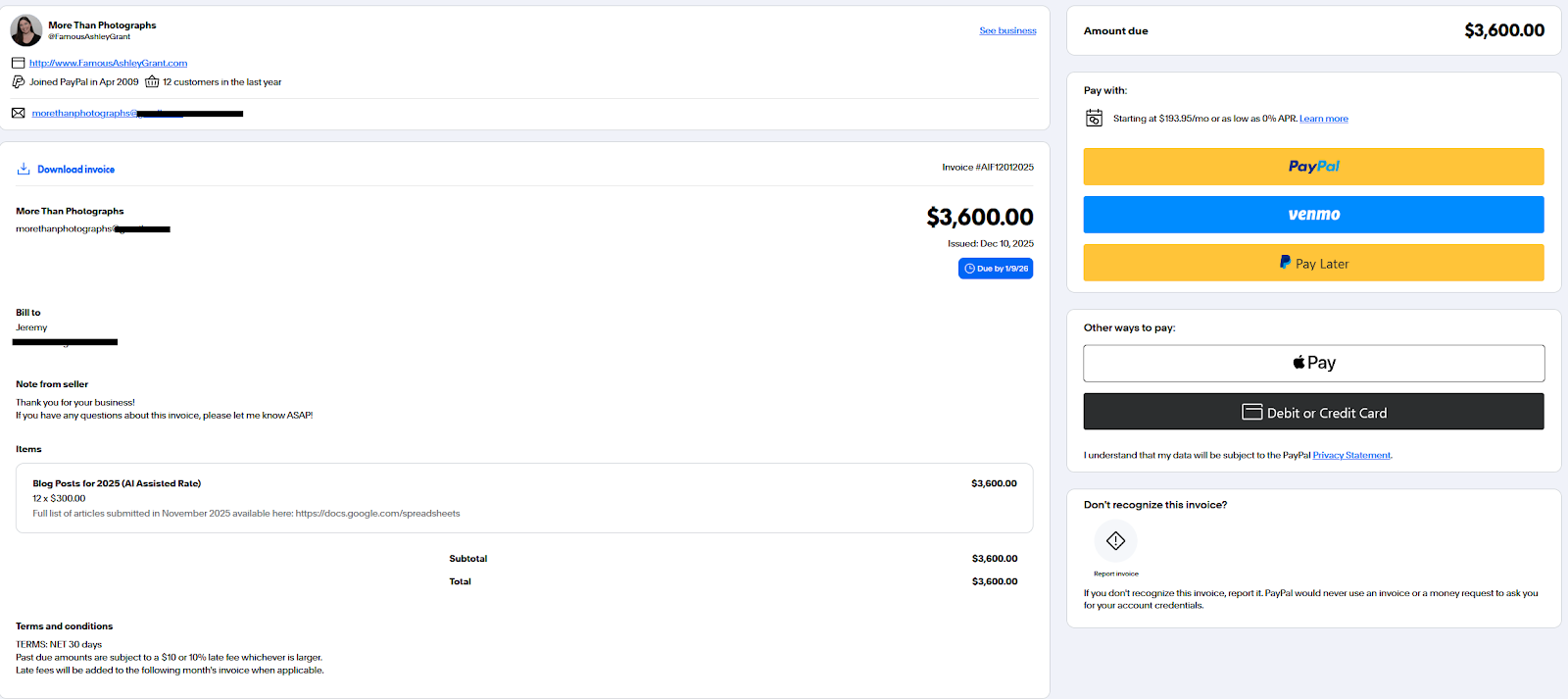
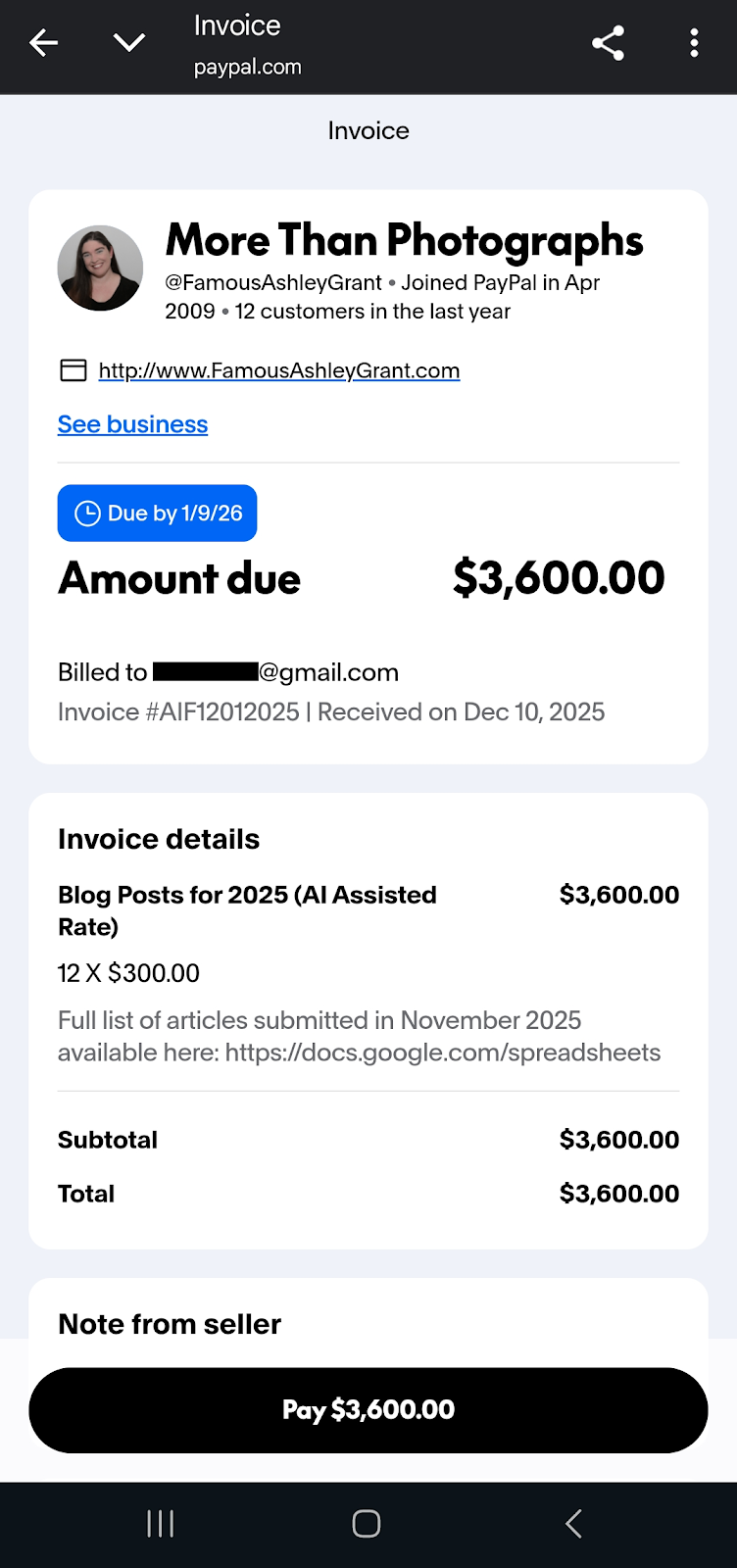
I personally use PayPal for several of my invoices because my invoices can easily be viewed on Mobile and desktop, and they are available as PDFs as well.
Here’s the desktop version of one of my invoices:
And here’s what it looks like via mobile device:
For businesses handling in-person transactions too, you may want to explore the benefits of having a POS system.
Interested in investing in technology that can bolster your loss prevention strategy? Learn more about GoDaddy’s POS solutions!
A/B test layout, language, and calls to action for conversion
Small changes make a surprising difference.
Test things like:
- Subject lines: "Invoice #123" vs. "Invoice Due [Date]."
- Button text: "Pay Now" vs. "Click to Pay."
- Where you place the total amount.
Try different approaches and see what works.
Step 4: Expand and modernize payment options
When clients can pay using their preferred method, you get the money faster. It's that simple. Let’s go over some of the newer payment options you might want to consider.
Offer direct deposit, digital wallets, and cryptocurrencies
Direct deposit is your baseline. It's fast (one to three business days), reliable, and professional.
Digital wallets like PayPal, Venmo, Apple Pay, and Google Pay have become standard.
Cryptocurrencies are also gaining traction, especially for international payments or tech-focused clients.
For a deeper dive on processing options, check out this credit card processing guide.
Enable one-click payment with hosted pages, QR codes, and pay-now links
Hosted payment pages let clients click a link and land on a secure payment page. QR codes are perfect for mobile users. Pay-now buttons embedded in your invoice email mean clients never have to leave their inbox.
Learn more about how to create QR codes for payments.
Leverage AI and automation for invoice creation and follow-ups
AI is a great tool for automating your invoice process. A lot of invoicing software today uses AI to do things like:
- Auto-fill invoice details based on your past work with that client
- Predict which clients are likely to pay late (so you can follow up proactively)
- Send automated reminders at strategic intervals
- Generate professional invoices in seconds instead of minutes
I use automation for my reminder emails now. The system sends gentle nudges automatically, so I don't have to remember or feel awkward about it.
Enable autopay for recurring payments
If you have monthly retainer clients or subscription-based services, autopay is your best friend.
Here's how it works: The client gives permission once, and their card gets charged automatically on the same day each month.
Pro tip: Always get explicit permission before setting up autopay.
Send a confirmation email with the date, amount, and payment method. Nobody likes surprise charges.
Integrate buy now, pay later (BNPL) options
BNPL services like Afterpay, Klarna, or PayPal Pay in 4 let clients split larger purchases into smaller payments.
Here’s how this can be helpful: A $5,000 project might feel daunting to a client. But four payments of $1,250? That's more manageable.
The catch: You typically get paid upfront minus a small fee (usually 2-6%), while the client pays the BNPL service over time.
Is it worth it? If BNPL means closing a deal you'd otherwise lose, or getting paid immediately instead of in 60 days, absolutely.
Provide secure mobile and contactless payment solutions
Around 60% of people check email on their phones. If people can't easily pay you from their mobile device, they'll wait until later.
Mobile payment solutions include tap-to-pay on smartphones, mobile card readers like Square, SMS payment links, and mobile wallets.
Contactless payments using NFC technology let clients tap their card or phone to a reader. It's fast, secure, and feels modern.
Quick security note: All reputable payment processors use encryption and tokenization to protect card data. Just make sure whatever system you choose is PCI compliant. For more on this, see this guide on PCI compliance.
You don't have to offer every payment method under the sun. Start with the basics (direct deposit, credit cards, PayPal), then add options as you grow.
Learn about how Dr. James Bogash used GoDaddy Payments to offer his patients flexible, mobile-ready ways to pay their invoices.
Step 5: Use incentives and penalties to encourage prompt payment
Give clients a reason to pay early, and consequences if they don't. Here are some proven ways to do this:
Offer tiered early payment discounts and loyalty rewards
You could try a tiered approach. For example:
- Pay within 5 days for 5% off
- Pay within 10 days for 3% off
- Pay within 15 days for 1% off
For clients who consistently pay early or on time, consider quarterly service discounts, priority scheduling, exclusive access to new services, or referral bonuses.
Provide flexible payment plans for large invoices
Big invoices can scare people. Payment plans solve this concern.
For projects over $5,000, you could offer a payment plan like this:
- 50% deposit before starting
- 25% at project midpoint
- 25% upon completion
Or for services, you could offer a payment plan like this:
- 40% upfront
- 30% at 30 days
- 30% at 60 days
The key is getting that initial deposit. It shows commitment and gives you working capital. This is huge for peace of mind, knowing you have revenue while you’re working instead of waiting for payment after all the work is complete.
Nothing worse than delivering everything only to not get paid.
Just make sure your payment processor can handle recurring or scheduled payments securely. For more on payment security, check out this PCI compliance guide.
Implement data-driven late fee structures and consider legal implications
Late fees work as an incentive, but they need to make sense financially and legally.
Here’s an example of the messaging I use for my late fees from one of my invoices:
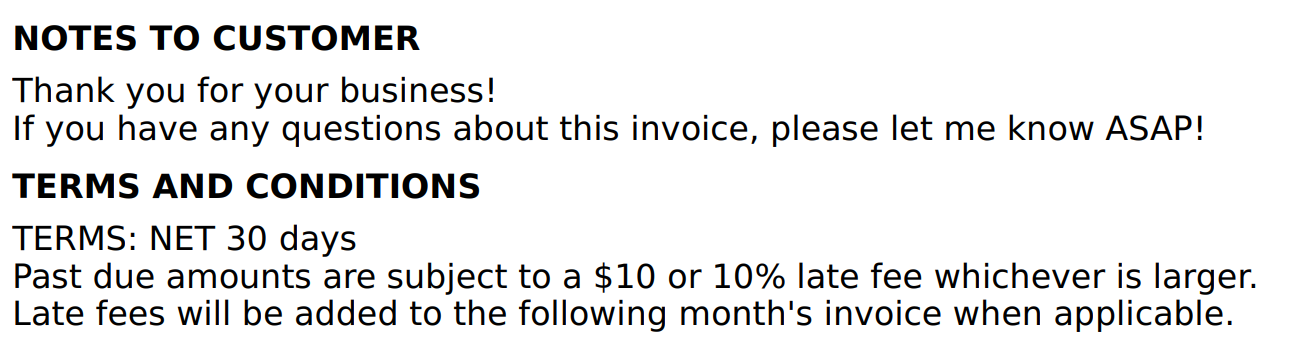
Before implementing late fees, you may want to:
- Check your local regulations.
- Consult with an accountant or lawyer.
- Include late fee terms in your original contract.
- State them clearly on every invoice.
Pro Tip: I always send a warning email before actually charging a late fee.
Nine times out of ten, the warning of late fees alone gets me paid immediately.
Step 6: Communicate effectively and manage relationships
Good communication prevents most payment problems before they start. And when issues do pop up? The right words at the right time can turn a potential disaster into a solved problem.
Set up automated but personalized follow-up sequences and payment reminders
Your reminder sequence could look something like this:
- 7 days before the due date: "Hi [Name], just a heads up that invoice #[number] is due on [date]. You can pay here: [link]. Let me know if you have any questions!"
- Due date: "Hi [Name], quick reminder that invoice #[number] is due today. Here's the payment link again: [link]. Thanks!"
- 3 days after the due date: "Hi [Name], I noticed invoice #[number] is a few days past due. Did you receive it okay? Is there anything preventing payment?"
- 7 days after the due date: "Hi [Name], invoice #[number] is now 7 days overdue. Please let me know when I can expect payment, or if there's an issue we need to resolve."
- 15 days after the due date: "Hi [Name], this invoice is now 15 days past due. As outlined in our agreement, late fees will apply after 30 days. Please submit payment by [date] to avoid additional charges."
Keep reminders friendly but direct. No need to apologize for asking for your money.
Use scripts and templates for difficult payment conversations
Sometimes, email doesn't cut it. You need to have an actual conversation.
Some sample scripts to consider:
- When they're avoiding you: "I've sent several reminders about invoice #[number]. I haven't heard back, which isn't like you. Is everything okay?"
- When they claim they never received it: "No problem, I'll resend it right now. Can you confirm you received it this time?"
- When they're having cash flow problems: "I understand things are tight. What if we split this into two payments?"
- When you need to get firm: "I value our working relationship, but this invoice has been outstanding for [X days]. I need payment by [specific date]."
A few quick tips on your tone:
- Stay calm.
- Ask questions instead of making accusations.
- Offer solutions.
- Set deadlines. "I'll call back on Friday" is better than "let me know."
- Document everything. If you have to go to court at some point, documentation can be the key to winning your case.
Monitor client payment behavior with CRM tools
You need to know who pays and who doesn't. Otherwise, you're flying blind.
Keep a simple spreadsheet that tracks client name, invoice date and amount, date paid, days it took to get paid, and any issues.
After a few invoices, patterns become clear. This data helps you decide whether to require deposits, offer shorter terms for reliable payers, or fire problem clients.
Patterns of payment behavior are why some of my former clients were required to pay in advance for every task they wanted to hire me for.
Step 7: Resolve disputes and address nonpayment
Even with perfect systems, sometimes clients still won't pay.
The most common nonpayment scenarios I've seen are:
- Client claims they never received the invoice (spoiler: they did, according to the software I used).
- They're disputing the quality of work (but they still published it!).
- They suddenly can't afford it.
- They ghost you completely.
- They keep promising "next week" for months.
Let’s explore some advice on how to handle each situation.
Apply mediation and negotiation tactics before escalation
Before you do anything drastic, try to work it out directly.
Find out what's happening, acknowledge their concerns, and offer solutions.
- Find out what's actually happening.
- Acknowledge their concerns.
- Offer solutions.
Utilize digital arbitration services and online dispute resolution platforms
If direct negotiation fails, don't jump straight to lawyers. Digital arbitration services provide neutral third parties who review your case and make binding decisions.
Popular platforms include Modria, Catalis (Formerly Matterhorn), American Arbitration Association (AAA), and Mediate.com.
Use these services when the client is willing to participate, the dispute is under $25,000, you want a resolution within weeks, and you'd rather avoid court.
Pro tip: Check your contract to see if it includes an arbitration clause.
Some contracts require arbitration before you can sue. Others prohibit it entirely. Please talk with a lawyer or CPA before you do anything.
Know when and how to use legal remedies or collections agencies
Sometimes you've tried everything, and the client still won't pay. Time to get serious.
Collections agencies specialize in recovering unpaid debts. They take a percentage (usually 25-50%), but you get something instead of nothing.
Top agencies for small businesses:
- Rocket Receivables (good for freelancers)
- National Enterprise Systems
- American Profit Recovery
Pro tip: The threat of collections often works better than the process of going through with it.
You could simply send a letter saying, "If I don't receive payment by [date], this will be sent to collections."
For debts under your state's limit (usually $5,000-10,000), small claims court is an option. If you’re dealing with large debts (over $10,000) or complex situations, you might need legal help.
At the end of the day, though, the best "legal remedy" is prevention. Good contracts, clear communication, and choosing clients carefully mean you'll rarely need lawyers or collections agencies.
Expert tips and innovations in 2026 and beyond
When it comes to getting paid, like everything, the world of invoicing and payment processing keeps evolving.
Here's what's hot right now:
- AI-powered invoicing that predicts which clients will pay late.
- Blockchain is making international payments faster and cheaper.
- Open banking lets businesses initiate payments directly from client accounts.
- Subscription models for service businesses, giving you a predictable monthly income.
Technology improvements make it easier for freelancers to get paid faster, while also providing a professional, streamlined payment process for clients. It’s a win-win.
Build a resilient, payment-savvy business
Getting paid faster isn't about being greedy. It's about running a sustainable business.
When you get paid on time, you can focus on doing great work instead of stressing about money. You can grow your business. You can actually enjoy being an entrepreneur instead of drowning in invoices.
Start small. Set up direct deposit today. Update your invoice template this week. Add a payment button next month.
Pick one or two things and implement them. You'll see results faster than you think.
And remember: You deserve to get paid for your work. Don't be afraid to ask for what you're owed. You've earned it.