
If you've searched online for how much it costs to make an app, you've probably seen estimates that are all over the map. One source says you can build an app for free, while another quotes $500,000 or more. It's frustrating when every answer seems different, and no one explains why.
The truth is that app costs vary because every project has different goals, features, and development needs. This guide explains what drives app development cost, what you can expect to pay at different stages, and how to choose an approach that fits your budget.
If you're new to the process, our “What is an app?” guide is a great place to start before diving into the numbers.
What you're actually paying for: the real cost formula
The simplest way to determine how much it costs to make an app is to use this formula:
Development Hours × Hourly Rate = Total CostHowever, this formula only accounts for the basic costs of app development. It doesn’t capture everything that goes into bringing an app to life. Most projects also include planning, interface design, testing, deployment, and ongoing maintenance, all of which contribute to the total investment. You may also need to budget for expenses like cloud hosting, third-party integrations, and app store fees.
The amount of time required for each development phase depends on the complexity of your app. Every app is unique, but you can use this table as a quick guide:
| App Type | Typical Cost | Typical Timeline | Recommended Build Approach |
|---|---|---|---|
| Simple app | Free to $20,000 | 2-8 weeks | AI-powered no-code platform or freelance developer |
| Mid-level app | $20,000-$75,000 | 2-4 months | AI-powered no-code platform, freelance developer, or small agency |
| Complex app | $75,000-$250,000 | 4-9 months | Development agency or dedicated development team |
| Enterprise app | $250,000-$500,000+ | 9-18+ months | Enterprise agency or in-house development team |
These estimates are broad starting points. Features, design requirements, integrations, and long-term maintenance all affect how much app development costs, and each of those factors plays an important role in your final budget. If you’re looking for a way to reduce costs, consider using a no-code AI-powered platform like GoDaddy Airo AI Builder.
GoDaddy Airo AI Builder
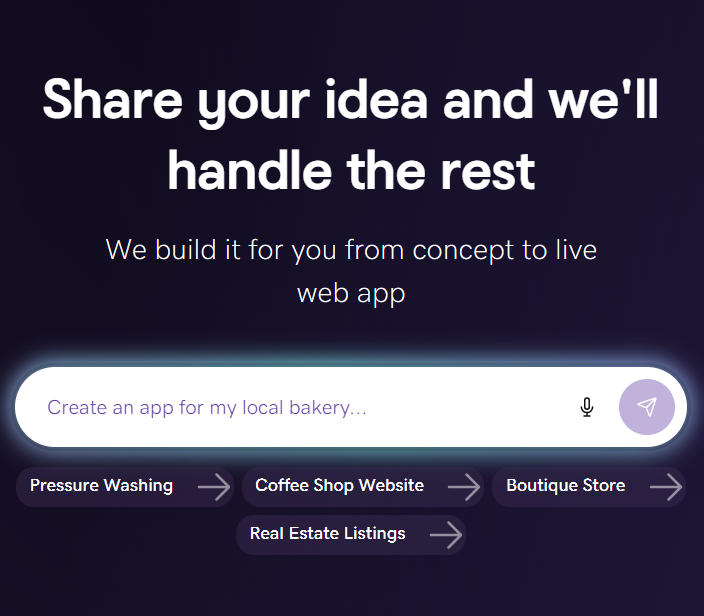
Describe your idea. We'll build your live website in minutes.
With a few prompts, Airo AI Builder generates your website, web app, pages, databases and logic in minutes — no coding required. Start for free with 50 AI credits a month. No credit card required.
Build for FreeTraditional vs AI-powered development
One of the biggest decisions you'll make before building an app is how you're going to build it. Not only does it affect overall app development costs, but it also influences your timeline, how much flexibility you have during development, and how you'll manage the app after it launches.
There isn't a single approach that's right for every business. A custom-built app can make sense for organizations with highly specialized requirements, complex workflows, or strict security and compliance needs, especially if they have access to a development team.
Most small businesses don’t need that level of complexity. An AI-powered builder, like GoDaddy Airo AI Builder, can handle many common use cases, such as appointment booking or simple inventory tracking, without high upfront investments. This ease of use, flexibility, and affordability have led to the rise of small business apps. Check out these examples of sites built with Airo AI Builder to see it in action.
Not sure which development approach fits your needs? Here’s a simplified look at each one:
| Traditional development | AI-powered development |
|---|---|
| High upfront investment | Lower upfront investment (sometimes even free) |
| Development often takes several months or longer | Development can often be completed in a few weeks |
| Usually requires developers, designers, and QA specialists | Designed for people without coding experience |
| Highly customizable for complex business needs | Ideal for many common small business use cases |
| Ongoing updates often require developer support | Many updates can be handled directly by the business owner |
If you’re new to AI, read this article for more tips on how to use AI as a small business owner.
Related: No-code vs. low-code vs. traditional
What drives app development costs? Key factors explained
No two apps have the same price tag because every project is built around a different set of goals, features, and technical requirements. Understanding the biggest cost drivers will help you estimate where your project falls and identify opportunities to save without sacrificing functionality.
App complexity and feature scope
The features you include have the biggest impact on app development cost. Every screen, workflow, and interaction requires planning, design, development, and testing, so a longer feature list almost always leads to a larger budget. Even features that seem simple on the surface often rely on complex systems working behind the scenes.
For example, a simple app that lets customers schedule appointments or browse your services is relatively straightforward and generally inexpensive to build. An app with user accounts, payment processing, real-time messaging, push notifications, and location tracking typically requires considerably more development time and higher costs.
One of the best ways to control costs is to focus on a minimum viable product (MVP). An MVP includes only the core features needed to solve your customers' primary problem. After you launch and collect feedback, you can continue adding new functionality over time instead of paying for everything upfront.
If you need some app ideas, check out this guide to things small businesses should automate. Prioritizing the tasks that save the most time for you and your customers often delivers the biggest return on your investment.
Platform choice: web app, iOS, Android, or all three
Your choice of platform is one of the earliest decisions you'll make, and it has a major impact on how much it costs to develop an app. Many first-time builders assume they need native mobile apps right away, but that isn't always the most practical or affordable option.
| Platform | Benefits | Considerations |
|---|---|---|
| Native iOS or Android | Lower initial cost than building for both platforms | Reaches users on only one operating system |
| Native iOS and Android | Maximum mobile user reach | Can nearly double development time and cost |
| Cross-platform mobile (ex. React Native or Flutter) | One codebase serves both platforms, often reducing costs by 30% to 40% compared to separate native apps | Some advanced features may still require platform-specific development |
| Web app | Works on virtually any device through a browser, launches faster, and doesn't require app store approval | May not need every native mobile capability |
If your goal is to launch quickly while keeping costs manageable, you can create a web app with GoDaddy. Our Airo AI Builder gives small business owners an accessible way to build a professional web app without the expense or complexity of traditional mobile app development, making it an excellent starting point for many first-time app projects like booking appointments, browsing products, managing memberships, or submitting service requests.
Development approach: native, cross-platform, no-code, or AI-built
Some development approaches require a full development team, while others let you launch an app with little or no coding experience. That has a huge impact on overall costs.
| App development approach | Typical cost | Best for |
|---|---|---|
| Native development | $50,000-$250,000 per platform | Apps with highly customized functionality, advanced performance needs, or enterprise requirements |
| Cross-platform development | $30,000-$150,000 | Businesses that need an app that works for both iOS and Android while keeping costs down |
| No-code platform | $500-$15,000 | Business apps with standard features and uses, like bookings, memberships, and customer portals |
| AI-powered development | Free to $5,000 per year | Small businesses that want to launch quickly with minimal technical experience |
Native development gives you the greatest level of customization, but it also requires the largest investment. If you build separate apps for iOS and Android, you'll typically pay for two development projects instead of one.
Cross-platform frameworks help reduce costs because developers can reuse much of the same code across both mobile operating systems. Many businesses choose this option when they want native-like experiences without maintaining two completely separate apps.
No-code platforms make app creation much more accessible, enabling you to build an app without coding. Instead of writing code, you assemble your app using visual tools and prebuilt components. AI-powered builders simplify the process even further by generating much of the app for you based on your goals. Read this “What are AI agents?” guide to learn more about how AI is used in development.
Design and UX requirements
Great apps are easy to use. That's why design typically accounts for about 20% to 25% of the total app development cost.
To keep costs lower, some small businesses use a template-based design approach. Because most of the layout and navigation are already built, they don’t need to spend money on custom design. Templates can work well for many small businesses that need a professional, polished app without extensive customization.
A custom UI and UX design takes more time because every screen, interaction, and visual element is created specifically for your business. The result is a more distinctive experience, but it also increases the overall project budget.
It can be tempting to reduce design costs, but keep in mind that poor usability often leads people to abandon an app after only a few uses. Investing in a clear, intuitive experience helps customers complete tasks more easily and encourages them to come back.
Backend, APIs, and third-party integrations
The screens and buttons your customers interact with are only part of the app. Most apps also rely on a backend, which handles everything happening behind the scenes. The more work your app needs to do in the background, the more development time and cost it typically requires.
A backend stores and manages information like customer accounts, appointment schedules, inventory, and order history. It also processes requests and makes sure information stays accurate and secure. For example, when a customer books an appointment or completes a purchase, the backend records that action and updates the necessary systems automatically.
Many apps also connect to third-party services through APIs, which allow different software tools to communicate with one another. Common examples include payment processors like Stripe, analytics platforms, email marketing tools, mapping services, and customer relationship management (CRM) systems. Every integration takes time to configure, test, and maintain, and some come with ongoing subscription or licensing fees.
AI-powered tools can simplify some of this work. With GoDaddy Airo AI Builder, you can connect supported third-party tools and services like customer reviews and testimonials, contact forms, booking systems, Yelp reservations, and Stripe payments through natural language prompts instead of building every integration manually. That can save valuable development time while still giving your app access to the business tools you rely on.
As a general rule, apps that store more data or connect with more external services require more development effort. Keeping your initial integrations focused on the essentials is another effective way to manage app development costs while building a strong foundation for future updates.
Developer type and location
Who builds your app can have just as much impact on your budget as the app itself. For example:
- Solo freelancer: $25-$100 per hour
- Boutique agency: $$75-$200 per hour
- Large agency: $150-$300+ per hour
Another app development cost consideration small businesses often overlook is that developer rates also vary significantly around the world.
- US and Canada: $100-$250+ per hour
- Western Europe: $75-$200 per hour
- Eastern Europe: $40-$100 per hour
- South America: $30-$80 per hour
- Asia: $20-$75 per hour
Lower hourly rates can reduce your upfront investment, but they're only one part of the equation. Communication, time zone differences, project management, and long-term support all influence the success of a project. For business-critical apps, experience and reliability often provide greater value than simply choosing the lowest quote.
Development phase, timeline, and urgency
App development happens in several stages, and each contributes to the final budget.
| Development stage | What it is | Budget share |
|---|---|---|
| Discovery | Defines the app's goals, target audience, features, and technical requirements before development begins. | 10-15% |
| Design | Creates the app's visual layout, navigation, and user experience to make it intuitive and easy to use. | 20-25% |
| Development | Builds the app's functionality, connects features, and writes the code that brings the app to life. | 40-55% |
| Testing and deployment | Checks the app for bugs and performance issues before launching it for users. | 15-20% |
Timing also affects your budget. Developers frequently charge premium rates for rushed projects because expedited work requires additional resources and tighter schedules.
Skipping discovery or reducing testing may seem like an easy way to lower app development costs, but those shortcuts often lead to expensive fixes later. For most small businesses, a phased approach is the smarter investment. Launching an MVP lets you validate your idea, gather customer feedback, and improve the app over time instead of paying for every possible feature before your first customer ever uses it.
Hidden and ongoing costs to budget for
The initial development cost is only part of your investment. Many first-time app builders focus on launch day and overlook the recurring expenses that keep an app secure, reliable, and running smoothly. Planning for these costs upfront helps you avoid budget surprises later:
- App maintenance: 15-25% of your original development cost per year
- App store fees: Apple charges $99 per year, and Google Play charges a one-time $25 fee
- Hosting and cloud infrastructure: $20-$500 per month
- Security updates: Varies widely by platform
- Payment processing: Usually around 2.9% + $0.30 per transaction
These recurring expenses can add up over time, but some AI tools for small business owners include some of these fees in your original plan, so you don’t have to worry about them popping up later. GoDaddy Airo AI Builder plans, for instance, include hosting and deployment costs.
How to build an app on a small business budget
Building an app doesn't have to mean hiring a development team or spending tens of thousands of dollars. AI-powered tools have made professional app development much more accessible for entrepreneurs with limited budgets.
GoDaddy Airo AI Builder is a practical starting point for businesses that want to launch quickly without learning to code. Instead of building every screen and feature manually, you describe your business and what you want your app to do. AI generates the foundation, allowing you to customize the design, content, and functionality before publishing.
This approach works well for many types of small businesses, including:
- Local service businesses
- Restaurants and cafes
- Retail stores
- Fitness studios and personal trainers
- Professional service providers
- Home service companies
If your business needs a professional app that customers can access without investing in custom development, GoDaddy Airo AI Builder can help you get there much faster than traditional development. To create a website using AI:
- Sign in to GoDaddy Airo AI Builder.
- Describe your business and the type of app you want to create.
- Review the AI-generated app and customize the content, branding, and features.
- Connect any supported business tools or integrations you need.
- Preview your app, make final adjustments, and publish it.
For many small business owners, this process takes a fraction of the time required for a traditional development project.
Want to explore more options? Read this article on vibe coding.
Frequently asked questions about app development costs
How much does it cost to make a simple app?
A simple app typically costs anywhere from free to around $20,000, depending on how you build it. AI-powered and no-code platforms are often the most affordable option for small businesses. Additional features, like user accounts, payments, and custom integrations, or hiring developers, will raise the price.
Can I build an app for free?
Yes, you can build an app for free using some AI-powered and no-code platforms, although advanced features or publishing options may require a paid plan. Free plans are a great way to validate your idea before investing more money. As your business grows, you can upgrade to access additional functionality.
Is it cheaper to use a freelancer or an AI app builder?
An AI app builder is usually much cheaper than hiring a freelancer. Freelancers often charge hundreds or thousands of dollars for even simple projects, while AI-powered builders use subscription pricing that makes professional app creation more affordable.
What's a realistic budget for a first-time founder?
A realistic budget for a first-time founder ranges from free to about $15,000 for many small business apps. Starting with an AI-powered or no-code platform can help you launch quickly and validate your idea before investing in custom development. If your app requires specialized features, you can always expand it later.
How long does it take to build an app?
It depends on the complexity of the project, but most apps take anywhere from a few days to more than a year to build. An AI-powered app builder can help you launch a basic business app in days or weeks, while custom-developed apps often take several months to complete.